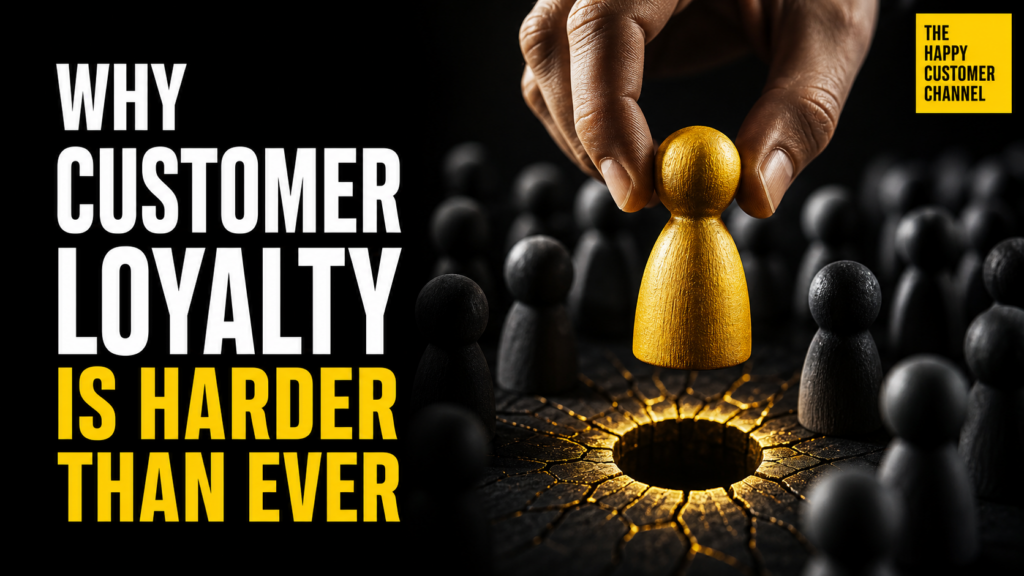
Customer loyalty is not dying. Weak customer loyalty strategies are being exposed.
The customer did not become disloyal overnight. They got better options. More visibility. Lower switching costs. More brands willing to do what your company still makes difficult.
Here’s the tension. Most companies are still trying to buy loyalty with points, discounts, and clever campaigns. Customers are judging loyalty by something much simpler. Did you do what you said you would do? Was it easy? Was it fair? Did you make me feel like staying was the obvious choice?
The reality is this: customers do not stay because of promises. They stay because the experience keeps proving the relationship is worth keeping.
The Loyalty Program Is Not the Loyalty Strategy
A loyalty program can help. Let’s be clear about that. Points, perks, early access, member pricing, and rewards all have a place. But they are not the strategy. They are tools.
What I’ve seen over and over is companies using loyalty programs to cover up problems they do not want to fix. Slow service. Confusing pricing. Weak onboarding. Poor communication. Products that do not match the sales pitch. Then leadership wonders why customers still leave even after getting a discount.
That is not a loyalty problem. That is an experience problem.
If a customer has to chase you for answers, your rewards program does not matter. If your billing feels unfair, the free gift does not matter. If your product fails at the moment they need it most, the points balance does not matter. The customer is not thinking, “At least I earned rewards.” They are thinking, “Why am I still dealing with this?”
This is where many brands get it wrong. They treat loyalty as a marketing function. Customers experience loyalty as an operational truth. It shows up in the invoice. The delivery window. The return process. The renewal call. The support ticket. The way your team handles a mistake.
Strong customer loyalty strategies do not start with the reward. They start with the relationship. They ask harder questions. Where are we creating friction? Where are we overpromising? Where are customers forced to repeat themselves? Where do we make it easier for a competitor to win?
Because that is what actually happens. Customers do not always leave in a dramatic moment. They leave after a series of small disappointments. One delayed response. One unclear policy. One price increase with no explanation. One broken handoff between sales and service. Eventually, the customer stops trusting the brand to make things easy.
And once trust is gone, discounts get expensive fast.
Customers Compare You to Their Best Experience Anywhere
Your customer is not just comparing you to your direct competitor. That mindset is outdated.
They are comparing your response time to the fastest company they deal with. They are comparing your checkout process to the easiest purchase they made last week. They are comparing your issue resolution to the brand that fixed a problem before they had to ask twice.
That is the new standard. It is not fair. It does not have to be fair. It is real.
In retail, customers expect clarity. In SaaS, they expect speed. In subscription businesses, they expect control. In B2B, they expect follow-through. Across every category, the customer has learned what good feels like. Once they experience it somewhere else, they bring that expectation to you.
Here’s what actually happens inside a business. Teams benchmark against the industry. Customers benchmark against their life. That gap is dangerous.
A company may say, “Our response time is better than the industry average.” The customer says, “I still waited two days for a simple answer.” A leadership team may say, “Our churn is within range.” The customer says, “I found someone easier to work with.” An operator may say, “That is our policy.” The customer says, “Then I am done.”
Loyalty gets harder when expectations rise faster than operations improve. And that is exactly where many companies are right now.
Customers are not asking for perfection. They are asking for consistency. They want to know what to expect. They want fewer surprises. They want problems handled without drama. When something goes wrong, they want ownership, not excuses.
That is why service recovery matters so much. A mistake does not automatically destroy loyalty. A bad response does. Customers can forgive a delay. They have a harder time forgiving silence. They can forgive an error. They have a harder time forgiving blame. They can forgive a product issue. They have a harder time forgiving a company that acts like the customer is the inconvenience.
The brands that win loyalty now understand this. They do not just design campaigns. They design moments of proof.
Retention Is Built in the Unsexy Moments
Retention is not built in the big announcement. It is built in the boring moments most companies overlook.
Onboarding. Billing. Delivery updates. Renewal reminders. Support handoffs. Returns. Follow-up emails. Cancellations. These are not glamorous. They rarely make the campaign deck. But they decide whether the customer stays.
What I’ve seen is simple. Companies love the front end of the relationship. The acquisition. The pitch. The close. The welcome message. Then the customer enters the actual operating system of the business, and the experience starts to fall apart.
The sales team promised speed. Implementation moves slowly. The website promised easy returns. The return process requires five steps. The subscription promised flexibility. Cancellation is buried behind a phone call. The brand promised premium service. Support sends a canned response.
That gap is where loyalty dies.
Customers remember the moment they feel trapped. They remember the moment they feel ignored. They remember the moment they realize the brand cared more before the purchase than after it.
This is why the best retention work starts before churn signals appear. By the time a customer stops opening emails, downgrades usage, ignores renewal outreach, or complains publicly, the relationship has already been damaged. You are not building loyalty at that point. You are trying to rescue it.
Real retention starts earlier. It starts with expectation-setting. Say what will happen next. Then make sure it happens. It starts with onboarding. Help the customer get value quickly. It starts with communication. Do not make them wonder. It starts with service recovery. Own the mistake before the customer has to fight for fairness.
And yes, it starts with leadership. Because loyalty is not just a marketing metric. It is a company behavior.
If pricing changes, explain it. If service levels slip, address it. If customers keep asking the same question, fix the source of confusion. If support teams are overwhelmed, do not pretend the brand is customer-obsessed while customers sit in a queue.
The customer can feel the difference between a company that says it values them and a company that is built to prove it.
Final Thoughts
The future of customer loyalty belongs to companies that stop asking, “How do we keep customers?” and start asking, “Where are we making customers question the relationship?”
That is the real work. Not louder campaigns. Not more points. Not another generic retention email. The work is removing the friction that quietly teaches customers to look elsewhere.
At the end of the day, loyalty is earned in the moments when leaving would be easy, but staying still feels right.
Common Questions
Why are customers less loyal than they used to be?
Listen, customers are not less loyal because they woke up one day and became difficult. They have more choices, more information, and less patience for bad experiences. What I’ve seen is that customers will stay when a company makes the relationship easy to trust. But when the experience creates friction, they start comparing. And once they find a better option, loyalty gets tested fast. The real issue is not disloyal customers. It is companies assuming yesterday’s experience is still good enough.
Do loyalty programs still work, or are they becoming outdated?
Here’s the reality: loyalty programs still work when the core experience works. They become outdated when they are used as a cover for bad service, confusing policies, or poor follow-through. A reward can strengthen a good relationship. It cannot save a broken one. Customers know when they are being rewarded and when they are being distracted. If the experience is frustrating, the points feel like noise. Fix the experience first, then use the program to add value.
What are the most effective ways to improve customer loyalty right now?
What I’ve seen is that the strongest moves are often the least flashy. Make onboarding clearer. Respond faster. Explain pricing changes before customers get angry. Close the loop after support issues. Remove policies that punish good customers for asking reasonable questions. If you want loyalty, reduce the number of moments where the customer has to wonder, “Why is this so hard?” That question is dangerous. It is usually the first step toward leaving.
How do we know if we have a loyalty problem or an experience problem?
At the end of the day, most loyalty problems are experience problems wearing a different name. Look at where customers complain, stall, downgrade, cancel, or stop engaging. Then look one step earlier. What happened before the behavior changed? Did they get confused? Did they wait too long? Did they feel misled? The answer is usually sitting in the operational details. Fix those details, and loyalty has something real to stand on.