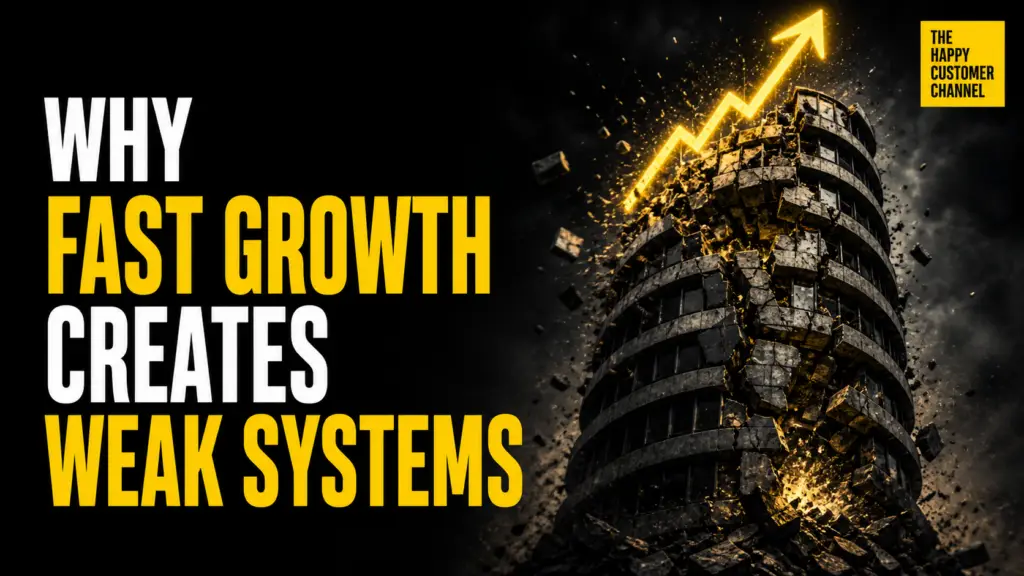
Fast growth does not create weak systems. It exposes the weak systems leadership was already tolerating.
That is the uncomfortable truth most leaders do not want to say out loud. When you are scaling a business, speed feels like proof. More revenue. More customers. More people. More activity. It looks like the machine is working.
But growth is not proof. Growth is pressure.
The reality is simple. If revenue, headcount, and demand grow faster than decision rights, process ownership, and leadership capacity, the business starts to crack. Not because people stopped caring. Not because the team suddenly got worse. Because the system was never built to carry the weight.
Growth Exposes What Was Already Fragile
When volume is low, weak systems can hide. A few smart people can remember the details. The founder can approve every important decision. A strong operator can clean up the mess before the customer feels it.
That works for a while. Until it does not.
Here’s what actually happens. Demand increases. The team gets busier. More customers need answers. More orders need fulfillment. More projects need oversight. More fires show up at the same time.
Then the cracks become visible.
Delays get longer. Mistakes repeat. Handoffs get sloppy. People start asking the same questions in different meetings. Leaders spend more time chasing updates than making decisions. Customers feel inconsistency. Teams feel pressure. And everyone starts saying the same thing: “We just need more people.”
Maybe. But not always.
What I’ve seen is this: fast growth often exposes a business that was running on memory instead of structure. It was running on relationships instead of clear ownership. It was running on heroics instead of repeatable execution.
That is dangerous.
Because heroics feel good in the moment. They make people feel useful. They make leaders feel like the team is committed. But heroics are not a system. They are a warning sign. If the business needs the same people to save the day every week, the system is already telling you the truth.
More People Can Make the Problem Worse
Hiring feels like the obvious answer when growth gets heavy. The team is stretched, so leadership adds bodies. More salespeople. More coordinators. More managers. More specialists.
On paper, capacity goes up.
In reality, confusion often goes up faster.
Headcount does not automatically create capacity. If the work is unclear, new people do not remove pressure. They add questions. Who owns this? Who approves that? Where does this live? Why are there three versions of the same process? Who tells the customer when something changes?
Those questions slow the business down.
This is where leaders get frustrated. They hired good people, but the operation still feels messy. The problem is not always talent. The problem is that the business added people before it clarified how work moves.
More people inside an unclear system create more meetings, more side conversations, more rework, and more dependency on leadership. The founder becomes the traffic controller. The COO becomes the emergency room. Managers become translators between teams that should already know how to work together.
That is not scale. That is complexity with a payroll attached to it.
The real question is not, “Do we need more people?” The better question is, “Can the people we already have execute without constant clarification?”
If the answer is no, hiring may not fix the issue. It may multiply it.
Strong systems do not eliminate judgment. They protect it. They give people enough clarity to move without waiting for permission on every step. They define ownership. They create a cadence. They reduce the number of decisions that require executive involvement.
That is when hiring starts to work.
Scale Is an Operating Discipline, Not a Revenue Milestone
The real work of scaling a business is not just selling more. It is building an operation that can deliver consistently when the pressure increases.
That sounds simple. It is not.
Because most companies celebrate demand before they build the discipline to absorb it. They push growth. They chase the next deal. They launch the next offer. They hire fast. They move fast. Then they act surprised when the customer experience gets uneven and the team starts burning out.
There is a pattern here.
The business grows faster than the leadership model. Decisions still sit with a few people. Priorities shift without explanation. Meetings multiply because the system cannot create clarity on its own. Teams start operating from assumptions. Customers start getting different experiences depending on who handles the account.
That is where trust gets damaged.
Not all at once. Slowly. Quietly. Through missed follow-ups, unclear expectations, inconsistent delivery, and slow responses. Customers may not understand your internal chaos, but they feel it. They feel when the business is stretched. They feel when nobody owns the outcome. They feel when growth has become more important than reliability.
And once customers feel that, you are no longer just managing operations. You are managing credibility.
Scale requires discipline. Decision discipline. Process discipline. Communication discipline. Leadership discipline.
It means leaders have to stop being the answer to every problem. It means teams need clear lanes. It means someone owns the process, not just the task. It means the business has to create rhythms that make performance visible before things break.
That is not bureaucracy. That is control.
Control does not mean slowing everything down. It means knowing what matters, who owns it, how it moves, and when leadership needs to step in. Without that, speed becomes noise. Activity replaces progress. Busy people become exhausted people.
At some point, the business has to mature.
Not become stiff. Not become corporate. Mature. There is a difference. A mature business can move fast because the foundation is clear. An immature business moves fast because nobody has stopped long enough to ask what is breaking.
Final Thoughts
Fast growth is not the enemy. Unexamined growth is.
The companies that scale well are not the ones that move blindly. They are the ones willing to look at the system before the system breaks them. They slow down the chaos, clarify ownership, protect the customer experience, and build execution that does not depend on constant rescue.
Growth should create leverage. If it only creates stress, the system is speaking.
Common Questions
How do I know if we’re growing faster than our systems can handle?
Listen, the signs are usually obvious before leaders admit them. If every meaningful decision still runs through the founder, you have a bottleneck. If teams are constantly chasing context, you have a clarity problem. If the same mistakes keep coming back, you do not have a people issue alone. You have a system that is not learning. Growth has outpaced the system when effort keeps increasing but consistency does not.
Should we slow down growth to fix operations?
Here’s the reality: you may not need to slow growth, but you probably need to slow the chaos. There is a difference. Keep serving demand where the business can deliver well. But stop adding unnecessary launches, side projects, and complexity on top of broken workflows. If the team is already overloaded, more motion is not leadership. Sometimes the strongest move is to pause, clean up ownership, and protect the customer from your internal mess.
Is this a people problem or a process problem?
What I’ve seen is that it is usually both, but not in the way people think. Good people can fail inside unclear systems. They burn energy trying to guess, translate, and recover. At the same time, weak systems often hide behind strong people for too long. Leaders mistake individual effort for organizational strength. At the end of the day, you need capable people inside a system clear enough to let them win.
What systems should we fix first when scaling a business?
Start closest to the money and the customer. That is where weakness gets expensive fast. Look at sales handoffs, onboarding, delivery, support, billing, decision-making, and cash visibility. Do not start with the prettiest process map. Start with the areas where confusion creates missed revenue, unhappy customers, or leadership bottlenecks. Fix the systems that protect trust first.