
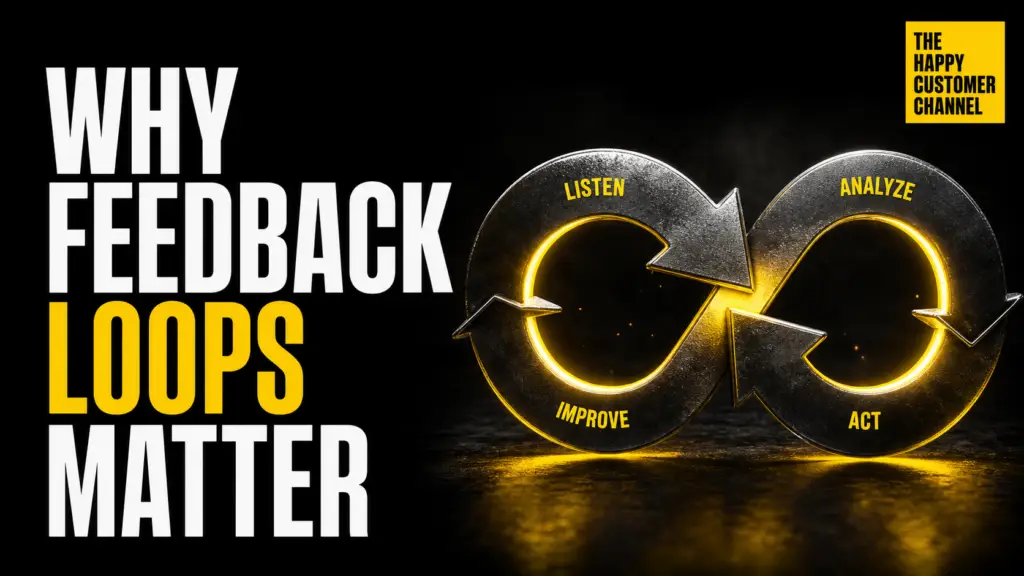
Your market is already telling you what is broken. The real question is whether your business is built to hear it before revenue makes the point.
Most teams say they want feedback. Then they bury it in surveys, dashboards, support tickets, Slack threads, and sales notes. That is not a feedback loop strategy. That is storage. The reality is simple: feedback only matters when it changes a decision.
What I’ve seen is this. Companies do not usually fail because the signal was missing. They fail because the signal had nowhere to go. No owner. No decision path. No follow-up. No accountability. So the market keeps talking, the team keeps noticing, and leadership keeps reacting too late.
Feedback Is Not a Report. It Is a Response System.
Feedback sitting in a dashboard does not help your customer. It does not help your team. It does not protect growth. It just makes the company feel informed.
There is a big difference between knowing and responding. Most companies are decent at collecting information. They ask customers to rate the experience. They measure NPS. They review support cases. They listen to sales calls. But then what?
Here’s what actually happens. The data gets discussed. A few people nod. Someone says, “That’s interesting.” Then the business goes right back to operating the same way. The loop is broken right there.
A real feedback loop strategy has four parts: a source, an owner, a decision path, and a response timeline. Where is the feedback coming from? Who is responsible for interpreting it? Where does the decision happen? When does the customer, team, or market see the response?
If you cannot answer those questions, you do not have a loop. You have noise.
The strongest companies treat feedback like an operating signal. Sales hears the same objection three weeks in a row. That matters. Customer success sees users stall during onboarding. That matters. Support keeps answering the same confusing question. That matters. Marketing sees prospects misunderstand the offer. That matters.
None of those are random events. They are patterns trying to get attention.
The problem is that most teams separate feedback from power. The people closest to the customer see the problem first, but they are not always the people who can fix it. So the signal gets trapped at the edge of the business. That is dangerous.
Feedback without action is not insight. It is delay.
The Market Punishes Slow Learners
The market rarely screams first. It whispers. Then it warns. Then it walks away.
Churn is feedback. Weak conversion is feedback. Stalled adoption is feedback. Declining retention is feedback. But by the time those numbers hit the leadership report, the pattern has usually been alive for weeks or months.
Revenue is often late to the scene. That is why dashboards can be dangerous when leaders treat them as the whole truth. They show outcomes. They do not always show the friction that created those outcomes.
Look earlier.
Look at the deals you keep losing for the same reason. Look at the customers who buy but never fully adopt. Look at the users who go quiet after setup. Look at the support tickets that should not exist if the product, process, or promise were clear.
Those are not minor issues. Those are early warnings.
What I’ve seen over and over is that teams ignore signals because each one feels small by itself. One complaint. One lost deal. One confused customer. One slow onboarding. Easy to explain away.
But patterns do not care about your excuses.
When the same issue shows up across sales, service, product, and retention, the market is not being difficult. It is being consistent. And consistency is where leadership should pay attention.
The companies that learn fastest are not always the biggest. They are not always the best funded. They are not always the most sophisticated. They simply shorten the distance between what the market says, what the team sees, and what leadership decides.
That is the advantage. Speed of learning. Speed of response. Speed of correction.
Build the Loop Where Work Actually Happens
Do not make feedback a special project. That is where momentum goes to die.
Build the loop inside the meetings and decisions that already run the business. Weekly sales reviews. Product planning. Customer success check-ins. Support escalations. Marketing message reviews. Leadership operating meetings.
That is where feedback belongs. Not in a beautiful research document that no one opens again.
The job is not to collect every opinion. The job is to identify the signals that should change behavior. That takes judgment. It also takes discipline.
Start with repeated feedback tied to money, retention, adoption, delivery, or trust. Those are the areas where friction becomes expensive fast. If customers are confused before they buy, your messaging has a problem. If they buy but do not adopt, your onboarding has a problem. If they adopt but do not expand, your value story may be weak. If they complain and nothing changes, your trust is leaking.
Here’s what a working loop looks like in real life. A customer-facing team brings a repeated pattern to the table. The team names the issue clearly. Leadership decides whether it matters now, later, or not at all. Someone owns the action. A deadline is set. The result is measured. Then the company tells the team or customer what changed.
That last part matters more than most leaders think.
Closing the loop builds trust. When customers see action, they give better feedback. When employees see action, they stop feeling like messengers into a void. The quality of the signal improves because people believe the business is actually listening.
And if you decide not to act? Say that too. “We heard this. We looked at it. Here is why we are not changing it right now.” That is still closing the loop. Silence is what damages trust.
The reality is that customers do not expect you to fix everything overnight. But they do expect evidence that you are paying attention.
Final Thoughts
Strong companies do not ask for feedback to look customer-centric. They build systems that force reality into the room.
A good feedback loop does not make the business softer. It makes the business sharper. It helps leaders stop guessing. It helps teams stop repeating preventable mistakes. It helps customers feel the company is improving because of what they said, not in spite of it.
At the end of the day, growth does not just come from pushing harder. It comes from learning faster than the problems can compound.
Common Questions
How is a feedback loop strategy different from just collecting customer feedback?
Listen, customer feedback is input. That is all it is. A feedback loop strategy turns that input into ownership, action, measurement, and follow-up. Without that, you are just collecting opinions and calling it customer focus. The difference is whether anything changes after the feedback comes in. If nothing changes, the loop never existed.
What feedback should we pay attention to first?
Here’s the reality. Start with the feedback connected to revenue, retention, adoption, delivery, or trust. That is where small issues become expensive. Do not chase the loudest voice just because it is loud. Look for repeated signals from customers, prospects, and frontline teams. When the same friction shows up in different places, pay attention.
How do we avoid overreacting to every complaint?
What I’ve seen is that strong teams separate noise from patterns. One complaint is worth noting. Repeated complaints from the right customers are worth investigating. You do not need to rebuild the business every time someone is unhappy. But you do need a way to see when frustration is no longer isolated. That is where discipline matters.
Who should own the feedback loop inside the company?
At the end of the day, leadership owns the system. Functional teams own the actions. Sales may own lost-deal patterns. Product may own usability friction. Customer success may own onboarding and retention signals. But if everyone “cares” and no one owns the path from signal to decision, nothing moves. Ownership is what turns listening into execution.