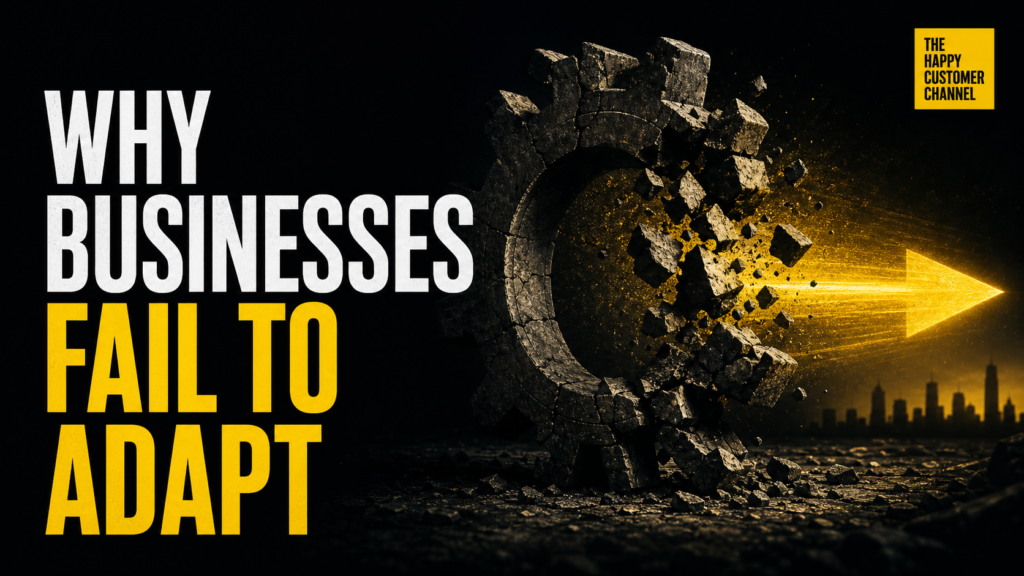
Most companies do not fail because the market moves too fast. They fail because leadership moves too slowly, and that is where business adaptability usually dies.
That may sound harsh. It is also true. Markets give warnings. Customers give warnings. Employees give warnings. Competitors give warnings. The problem is not that leaders never see change coming. The problem is that they keep negotiating with reality.
They want the next chapter without disturbing the current one. They want innovation without risk. They want transformation without discomfort. They want speed without changing who gets to make decisions. That is not adaptation. That is theater.
Business adaptability breaks down when leaders protect the system that made them successful instead of rebuilding it for what comes next.
The Market Usually Warns You First
Businesses rarely get blindsided. Not really. There are signals before the fall.
Customers start asking different questions. Sales cycles stretch. Margins get tighter. Your best people get frustrated. A competitor shows up with a simpler offer. A new channel starts pulling attention away from your old one. The clues are there.
Here’s what actually happens. The company notices the shift, but it explains it away. “It’s temporary.” “Customers will come back.” “The team just needs to execute better.” “Let’s wait for one more quarter of data.”
That last one is dangerous. Waiting for perfect proof feels responsible. It feels mature. It feels like leadership. But many times, it is just fear dressed up as discipline.
By the time the evidence is obvious, the advantage is gone. The market has already moved. Customers have already changed their expectations. Competitors have already taken the space you were still debating.
What I’ve seen is simple. Companies often have the information they need. They just do not have the courage to act on it while the current model is still producing money. That is the hard part. It is easy to change when you are desperate. It is much harder to change when the old machine is still running.
But that is when real leadership shows up. Before the crisis. Before the headlines. Before the customer leaves.
Success Becomes the Trap
The stronger the old model, the harder it is to challenge. That is the part most leaders underestimate.
Success creates confidence. Then confidence creates routine. Then routine becomes protection. Before long, the business is not designed to learn. It is designed to defend.
People keep funding what worked. They keep measuring what is familiar. They keep promoting the operators who protect the old system. Nobody says, “Let’s become irrelevant.” It happens more quietly than that.
It happens in budget meetings. It happens in performance reviews. It happens when a new idea gets buried because it does not fit the current reporting structure. It happens when the customer is changing faster than the leadership team is willing to admit.
This is where business adaptability gets tested. Not in a workshop. Not in a slide deck. Not in a new slogan printed on the wall. It gets tested when leaders have to choose between protecting today’s numbers and building tomorrow’s relevance.
The reality is, most companies say they want innovation, but they reward predictability. They say they want agility, but they punish people who challenge the process. They say they want transformation, but they keep every old priority alive.
You cannot adapt while trying to protect every sacred cow. You cannot move faster while keeping every approval layer. You cannot build the future with incentives designed for the past.
That is why success can become the trap. The business does not fail because it lacks talent. It fails because the system is built to resist the very change it claims to want.
Adaptability Is a Leadership Test
Adaptability is not a software tool. It is not a meeting format. It is not a consulting phrase.
It is a leadership discipline.
A business adapts when leaders make decisions before they are forced to. That means moving capital. Changing incentives. Cutting projects that no longer matter. Backing new bets before the spreadsheet feels safe. It means saying no to good things so the company has enough energy for the right things.
That is where many leaders hesitate. They want certainty first. But certainty usually arrives late. By then, the customer has already formed new habits, the market has already reset, and the company is left reacting instead of leading.
Here’s the reality. Adaptation always carries risk. But standing still carries risk too. The difference is that standing still feels safer because it is familiar. It has a process. It has reports. It has historical data. It has people defending it because their careers were built inside it.
But familiar does not mean safe. Familiar can be the slowest way to lose.
Leaders who build adaptable companies ask harder questions. What are customers telling us that we do not want to hear? What are we funding out of habit? What decision are we delaying because it will upset the room? What part of the business would we build differently if we were starting today?
Those questions create pressure. Good. Pressure reveals whether the company is serious or just comfortable.
The best leaders do not wait until everyone agrees. They listen. They study the pattern. Then they move. Not recklessly. Not emotionally. But decisively.
Final Thoughts
The companies that survive change are not always the smartest. They are not always the biggest. They are not always the best funded.
They are the ones willing to confront reality while they still have options.
That is the real work. Not pretending the market will slow down. Not hiding behind old wins. Not calling every delay a strategic pause. At the end of the day, adaptability is a choice leaders make long before the business is forced to make it for them.
Common Questions
Why do businesses struggle to adapt even when they know change is happening?
Listen, knowing is easy. Acting is expensive. Real adaptation threatens budgets, roles, habits, and power structures. That is why leaders delay. They are not always ignoring the market. Sometimes they are protecting the internal peace. But the market does not care about internal peace. It only rewards relevance.
How do I know if my business is becoming too slow to adapt?
Here’s the reality. Look at how long it takes to make a real decision. Look at how often weak projects get extended because nobody wants to own the hard call. Look at whether customer feedback changes behavior or just gets discussed. If every meaningful move requires six meetings, three committees, and political approval, you have a speed problem. And speed problems become customer problems.
Is adaptability more about strategy or culture?
What I’ve seen is that it starts with leadership, then shows up in culture. Strategy matters, but culture determines whether the strategy actually moves. People watch what leaders reward. They watch what leaders tolerate. If leaders reward short-term comfort and punish smart risk, the culture will not adapt. It will comply. There is a big difference.
What is the biggest mistake leaders make during transformation?
At the end of the day, the biggest mistake is trying to transform without changing the operating model. Leaders add new language on top of old behavior. They announce a new direction but keep the same incentives, same approvals, same power centers, and same decision speed. Then they wonder why nothing changes. Transformation is not what you say in the kickoff meeting. It is what you are willing to stop, change, fund, and measure differently.