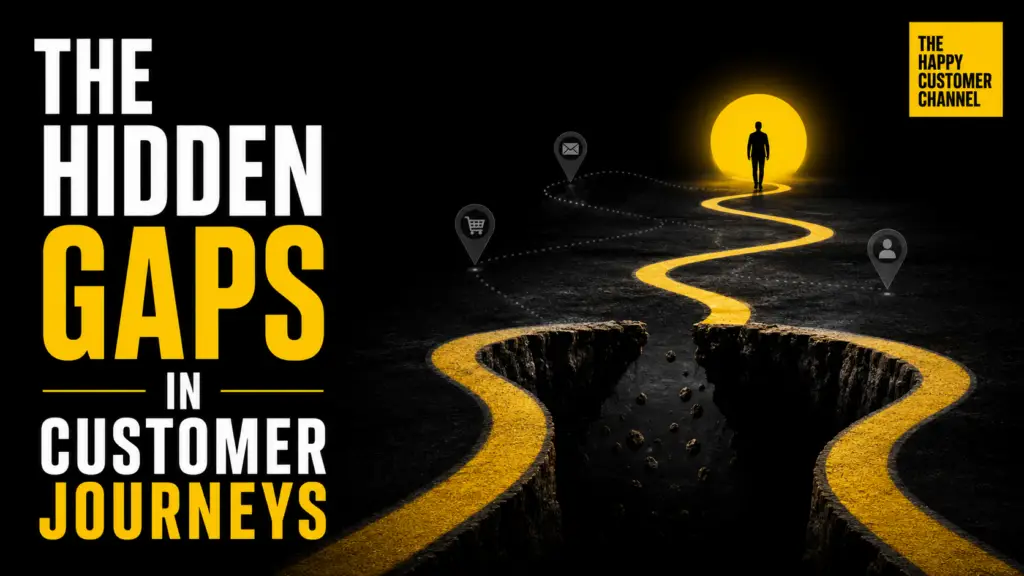
Most customer journey maps look clean because the real damage is hidden between the steps. That is where customers lose trust.
And that is why customer journey mapping gets misunderstood. Companies build a polished visual. They align the stages. They name the touchpoints. They label the emotions. Then the same complaints keep showing up.
Why? Because the customer is not living your diagram. They are living the handoff from sales to onboarding. The silence after the first support ticket. The billing surprise nobody explained. The repeated story they have to tell three different people. That is the real journey.
The Map Is Not the Journey
Here’s what actually happens. A team gets in a room. They map the buying process. They map onboarding. They map support. Everyone agrees it looks right. The wall gets covered with sticky notes. The final version gets turned into a clean slide.
Then reality walks in.
A customer signs the contract and waits five days for the next step. Nobody explains what happens after payment. The onboarding team asks questions the sales team already answered. Support gives technically correct answers that do not solve the customer’s real problem. Billing sends a notice that sounds cold and automated. Each team thinks they did their job. The customer feels passed around.
That is the gap.
Most maps are built from the company’s point of view. They show how the business believes the journey should work. They do not always show what the customer has to repeat, chase, wait for, clarify, or tolerate. That difference matters. It is the difference between a process map and an experience map.
What I’ve seen is simple. Leaders often fall in love with the visual. But customers do not care about the visual. They care about momentum. They care about clarity. They care about whether the company remembers what was promised and makes it easy to move forward.
If the map does not expose friction, it is not doing its job. It is decoration.
The Real Gaps Hide in the Handoffs
Customers rarely leave because of one bad moment. That is the comfortable story companies tell themselves. The reality is more uncomfortable. Customers leave because small breakdowns stack up.
Sales promises speed. Onboarding starts slow. Marketing promises simplicity. The product requires workarounds. Support promises help. The customer gets a link to an article they already read. Success promises partnership. The customer only hears from them before renewal.
No single team thinks it failed. That is the danger.
Each department optimizes its own lane. Sales wants conversion. Marketing wants leads. Product wants adoption. Support wants ticket closure. Finance wants clean collections. Those goals are not bad. But when nobody owns the spaces between them, the customer becomes the project manager.
That is where trust breaks.
The customer does not separate your teams the way you do. They do not say, “That was a sales issue, not an onboarding issue.” They say, “This company is hard to work with.” That sentence should make every leader pay attention.
The biggest journey problems live between departments. The handoff after purchase. The transition from implementation to support. The gap between the proposal and the actual service. The delay between a complaint and a real answer. These are not minor details. These are moments where the customer decides if your company is reliable.
Here is the test. Ask your team where customers get stuck. If every department points somewhere else, you found the problem. The journey has no true owner.
Map What Customers Prove, Not What Teams Believe
Strong customer journey mapping has to start with proof. Not opinions. Not assumptions. Proof.
Look at support tickets. Read the complaints. Listen to calls. Review churn notes. Study refund reasons. Check where deals stall. Look at onboarding delays. Watch where customers go silent. The truth is usually already inside the business. Most teams just do not connect it.
Surveys can help, but they are not enough. Customers often tell you how they feel after the damage is done. The better signal is behavior. Where do they slow down? Where do they ask the same question again and again? Where do they stop responding? Where do they escalate?
That is where the real map begins.
A useful journey map should create decisions. Who owns this handoff? What message needs to change? What promise is being made too early? What step creates confusion? What delay is costing trust? What internal workflow makes the customer work harder than they should?
If your map does not change ownership, workflows, messaging, or accountability, then it is not a business tool. It is a meeting artifact.
And let’s be honest. Many companies already know where the friction is. The frontline team knows. Support knows. Customer success knows. Sales knows where expectations get messy. The issue is not always discovery. The issue is courage. It takes courage to admit the customer journey is not as smooth as the company story says it is.
Final Thoughts
A customer journey map should make leaders uncomfortable. If it only confirms what the company already believes, it is not useful. The real value comes when the map exposes where the business is making customers work too hard.
That is the point. Not a prettier diagram. Not a better workshop. A better operating system for the customer. Because at the end of the day, customers do not reward companies for having a map. They reward companies that remove the gaps.
Common Questions
Why do customer journey maps often fail to improve customer experience?
Listen, most maps fail because they are built around the company’s process instead of the customer’s reality. The team maps what they think happens, not what the customer actually feels and experiences. That is why customer journey mapping can become a nice-looking exercise with very little impact. If the map does not include delays, complaints, repeated questions, and failed handoffs, it will not change much. You cannot fix what you refuse to look at.
How do we find the hidden gaps in our customer journey?
Here’s the reality. The gaps are usually not hidden from the frontline. They are hidden from leadership. Start with the places where friction repeats: support tickets, churn reasons, onboarding delays, refund requests, abandoned forms, and escalation notes. Then ask one simple question. Where is the customer waiting, repeating themselves, or chasing clarity? That is where the gap lives.
Who should own the customer journey map?
What I’ve seen is that one department cannot own the whole journey alone. Marketing shapes expectations. Sales makes promises. Product delivers the experience. Support handles friction. Success protects the relationship. If only one team owns the map, the map will be biased. Ownership needs to be cross-functional, but accountability still has to be clear.
How often should we update the customer journey map?
At the end of the day, the map should change when the customer experience changes. If your product changes, update it. If your sales motion changes, update it. If complaints start clustering in a new place, update it. A quarterly review is a good rhythm for most teams, but do not wait for a calendar invite if the data is already telling you something is broken. The customer is giving you the signal now.