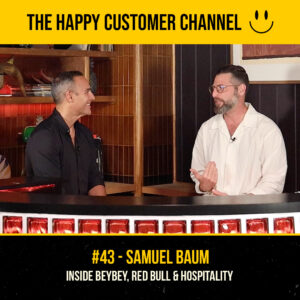
FULL EPISODE HERE
How Samuel Baum Thinks About Hospitality, Brand Building, and Miami’s Rise
Hospitality businesses often talk about service, ambiance, and customer experience as separate ideas. Samuel Baum’s perspective is sharper: the real business is creating meaningful experiences that people want to return to. That shift in thinking changes how brands are built, how venues are operated, and how markets should be understood.
In this episode, Baum explains how growing up in Miami shaped his understanding of hospitality as a cultural and emotional business, not just a transactional one. Drawing on his experience with Red Bull and his work building BeyBey Miami, he outlines why authenticity, local relevance, and operational discipline matter more than hype.
The central idea is clear: winning hospitality brands understand place, design around real human behavior, and execute a consistent vision across every customer touchpoint.
What This Episode Covers
This conversation connects hospitality, brand strategy, market expansion, and operations into one practical business philosophy. Baum shows why strong brands are built through cultural fluency and disciplined execution, not copy-paste concepts or surface-level marketing.
- Why hospitality is really about designing emotional connection
- How Miami’s long-term development led to its current boom
- What Red Bull understood about supporting creators and communities
- Why local authenticity beats imported concepts
- How BeyBey Miami was built for flexibility, warmth, and repeat visits
- Why operational consistency starts with a clear core vision
- How customer intent changes throughout the day and night
Key Insights
The Best Hospitality Brands Sell Belonging
Baum’s view of hospitality starts with a simple premise: people are not just buying food, drinks, or access. They are buying a feeling. The strongest brands create an environment where guests feel connected, understood, and comfortable enough to return again and again.
This matters beyond restaurants or nightlife. In any customer-facing business, products can be copied. Belonging is harder to replicate. When a brand consistently delivers an emotional outcome, it builds loyalty that goes beyond price or convenience.
As Baum puts it, hospitality is about “creating this fantasy that becomes something tangible.” That is a useful definition for business leaders: experience is not decoration around the offer; experience is the offer.
Authenticity to Place Is a Competitive Advantage
One of the clearest themes in the episode is that place matters. Baum argues that brands rooted in a city’s real culture are more durable than those built from imported assumptions. Outsiders often underestimate this because they view expansion as a matter of bringing a successful concept into a new market. In practice, that often fails.
Authenticity creates trust. Customers can tell when a business reflects the energy, rhythms, and values of a city versus when it is simply using the city as a backdrop. In markets like Miami, cultural fluency is not optional. It is part of the business model.
This is one reason BeyBey Miami was developed as a locally driven concept rather than a generic hospitality import. The goal was not to force a prebuilt idea into the market. It was to create something that fit how people in Miami actually wanted to spend time.
Miami’s Growth Was Structural, Not Accidental
Baum pushes back on the idea that Miami’s rise is a passing trend. His argument is that the city’s boom was years in the making. Redevelopment, infrastructure, and cultural momentum had already been building. Remote work simply accelerated what was already underway by increasing talent mobility, population growth, and local spending power.
This is an important business lesson. Markets often look like overnight success stories from the outside, but the real drivers are usually long-term investments that finally align at the right moment. Leaders who understand that are better positioned to enter early, invest correctly, and avoid dismissing emerging markets too soon.
Baum’s point that Miami is “not a joke of a city” reflects a broader strategic truth: serious opportunities are often missed when decision-makers rely on outdated narratives rather than current market realities.
Great Marketing Enables Culture Instead of Interrupting It
Baum’s experience with Red Bull highlights one of the most valuable ideas in the episode: the best marketing does not force brand presence into a community. It supports people and ideas that already have genuine momentum.
He points to an approach where the goal was not to put a sign at an event just to gain visibility. The better question was, “How do we give wings to that?” That mindset reframes marketing from exposure-buying to ecosystem-building.
For business leaders, the implication is significant. Brand growth is often stronger when companies help creators, operators, or communities scale what they are already doing well. Strategic support, infrastructure, amplification, and execution can generate deeper brand affinity than traditional promotional tactics.
Expansion Fails Without Local Relationships
One of Baum’s strongest messages is that market expansion breaks down when companies assume a successful concept can simply be copied into a new geography. The issue is not ambition. The issue is cultural blindness.
Every city has its own social codes, customer expectations, spending patterns, and definitions of value. Without local relationships and trusted insight, businesses often misread demand and overestimate the power of brand recognition.
The takeaway is straightforward: expansion should begin with listening, not launching. Companies need local operators, creators, and teams who understand the market from the inside. Relevance has to be earned before loyalty can be expected.
A Bigger Market Can Create More Winners
Baum also makes an important point about competition. As markets grow, the outcome is not always zero-sum. A larger customer base can support multiple successful businesses, especially when the market attracts more talent, more capital, and more consumer demand.
That kind of growth can raise standards across the board. Instead of simply increasing pressure, it can create room for specialization, better execution, and stronger concepts. In practical terms, this means expanding markets often reward businesses that are clear about who they serve and why they matter.
For leaders, this is a useful reminder that competitive intensity is not always a reason to hold back. In the right market, growth can increase opportunity faster than it increases saturation.
Operational Excellence Starts With a Clear Vision
Baum repeatedly returns to one principle: “Everything needs to go back to the core vision.” This is not just branding language. It is an operating requirement.
In hospitality, inconsistency usually comes from a disconnect between concept and execution. A brand may know how it wants to be perceived, but if that vision is not translated into service standards, training, design choices, and team behavior, the customer experience breaks down.
The strongest operators define their ethos in practical terms. They make sure every team member understands not only what to do, but what feeling they are responsible for creating. That alignment is what turns a concept into a reliable experience.
The Best Concepts Match Changing Customer Intent
Another standout idea from the episode is that successful venues are designed around how customer intent evolves over time. People do not want the same thing at every hour of the day or every phase of a night out. Their expectations shift, and the best concepts are built to shift with them.
This is where flexibility becomes strategic. A venue that can accommodate different moods, use cases, and energy levels creates more value from the same footprint. It also increases repeat visitation because it stays relevant across more occasions.
BeyBey Miami reflects this thinking. Rather than serving a static use case, it was designed with warmth, adaptability, and a real understanding of how guests want to engage in the space. That design philosophy is useful for any business trying to increase frequency, retention, and customer lifetime value.
Framework
Experience-as-Brand Framework
- Start with the emotional outcome you want the customer to feel.
- Build the environment, service, and programming around that feeling.
- Ensure every touchpoint reinforces the same identity.
- Turn the experience into something customers form a relationship with.
This framework is especially useful for hospitality, retail, and service brands. It shifts strategy away from isolated features and toward a coherent emotional product.
Give Wings to Ideas
- Identify people or communities creating genuine momentum.
- Understand what they actually need to grow.
- Provide strategic support beyond money or logo placement.
- Help them scale audience, infrastructure, and execution.
- Win by becoming an enabler of culture rather than an advertiser inside it.
This approach offers a smarter model for brand partnerships, community building, and creator marketing.
Local Market Entry Framework
- Study the city’s true culture, not its tourist stereotype.
- Build relationships with trusted local operators and creators.
- Adapt the concept to the market rather than forcing a replica.
- Bring a high standard, but integrate local intelligence into execution.
- Earn relevance before expecting loyalty.
For companies expanding into new markets, this framework reduces the risk of superficial entry and improves long-term fit.
Core Vision to Operations Model
- Define the brand ethos in simple behavioral terms.
- Translate that ethos into marketing, design, service, and training.
- Create overlap between specialized teams to prevent silos.
- Train staff on both practical execution and emotional intent.
- Continuously gather feedback and refine the experience in real time.
This model is what allows a concept to scale without losing its identity.
Key Takeaways
- Hospitality brands win by creating emotional connection, not just selling products.
- Authenticity to place is a durable advantage in competitive markets.
- Miami’s rise reflects structural growth, not temporary hype.
- Marketing is more effective when it supports culture rather than interrupts it.
- Expansion into new markets requires local trust and cultural fluency.
- Growing markets can create more winners and raise operating standards.
- A clear core vision is the foundation of consistent service and brand execution.
- Flexible concepts outperform static ones because customer intent changes over time.
Who This Is For
This episode is especially relevant for:
- Hospitality founders and operators building differentiated venues
- Brand leaders looking for smarter approaches to community-driven marketing
- Business owners expanding into new cities or regional markets
- Sales and customer experience teams focused on retention and loyalty
- Investors and operators evaluating Miami and similar high-growth markets
- Leaders who want to align brand positioning with operational execution
Watch the Full Episode
Watch the full conversation with Samuel Baum to hear how he connects hospitality, local culture, marketing strategy, and operational discipline into one clear business philosophy. His perspective is especially useful for leaders building experience-led brands in fast-changing markets.
FAQ
What is Samuel Baum’s core view of hospitality?
Baum sees hospitality as the business of creating meaningful experiences and emotional connection. In his view, the product is not just food, nightlife, or service. It is the feeling people associate with the space and whether they want to return.
Why does Baum believe authenticity matters so much in hospitality?
He argues that authenticity to place creates stronger brands than imported concepts. Businesses that understand a city’s real culture, rather than relying on surface-level assumptions, are more likely to earn trust, relevance, and repeat customers.
What can business leaders outside hospitality learn from this episode?
The biggest lesson is that growth comes from aligning brand promise with real customer behavior. Whether entering a new market, launching a service, or building a brand, leaders need cultural understanding, operational consistency, and an experience customers genuinely want to join.