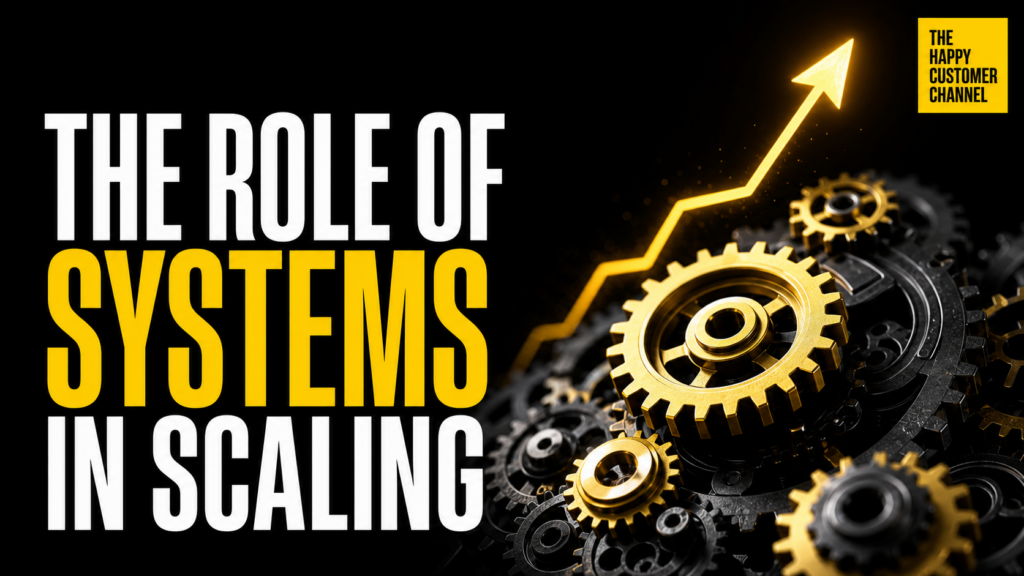
If your business only works when the founder is in the room, you don’t have a scaling problem. You have a systems problem.
That is the hard truth. Growth does not magically create discipline. It exposes the lack of it. And this is where scalable business systems become the difference between a company that grows with control and a company that grows into chaos.
I’ve seen this pattern over and over. A founder builds momentum through sheer force. They sell. They solve. They approve. They remember every client detail. They jump into delivery. They save the relationship when something goes wrong.
At first, it works. Then it becomes the ceiling.
The company starts depending on the founder’s memory, judgment, speed, and emotional stamina. That is not scale. That is dependency dressed up as leadership. And the longer it goes unchecked, the harder it becomes to fix.
Growth Exposes What Was Already Broken
Here’s what actually happens when a business grows.
The cracks get louder.
The sales team makes promises delivery cannot support. Operations starts improvising. Customer experience becomes inconsistent. Finance chases missing information. Leaders spend more time resolving confusion than making real decisions.
None of that starts because the company grew. It was already there. Growth just removed the hiding places.
When the business is small, people compensate. They walk across the room. They text the founder. They remember the workaround. They know which client needs special handling because “we’ve always done it that way.”
That can feel fast. It can even feel entrepreneurial. But it is fragile.
What I’ve seen is this: many businesses confuse speed with absence of structure. They think systems will slow them down. So they avoid documenting decisions, defining ownership, and building repeatable workflows. Then volume increases and everyone gets buried.
The founder becomes the operating system.
That is dangerous.
Because a founder can make fast decisions, but they cannot be everywhere. They can protect quality for a while, but they cannot personally inspect every handoff. They can calm customers, but they cannot be the permanent safety net for every broken process.
At some point, the business has to stop relying on individual heroics and start building organizational capability.
That shift is not optional. It is the line between a founder-led hustle and a company that can actually scale.
Software Is Not a System
Let’s call this out directly.
Buying software does not mean you built a system.
A CRM is not a sales system. A project management tool is not an operations system. A dashboard is not a leadership cadence. These tools can help. They can support execution. But they cannot replace clarity.
The reality is, most teams do not fail because they lack another app. They fail because nobody has clearly defined how the work should move.
Who owns the next step? What does “done” mean? When does a handoff happen? What information is required before work moves forward? What gets escalated? Who decides when there is conflict? What metric tells us the system is healthy?
Those are the questions that matter.
Scalable business systems answer those questions before the pressure hits.
They remove the guessing. They reduce the rework. They stop leaders from having to repeat themselves every week. They make quality less dependent on personality and more dependent on process.
And no, that does not mean turning your company into a machine with no judgment. That is not the goal. The goal is to create enough structure so good people can use their judgment in the right places.
There is a big difference.
Bad systems create bureaucracy. Good systems create freedom. They free the founder from approving everything. They free managers from chasing updates. They free employees from wondering what is expected. They free customers from experiencing a different version of your company depending on who picks up the request.
That last part matters.
Because customers feel the absence of systems. They may not use those words, but they feel it. They feel the missed follow-up. They feel the inconsistent answer. They feel the delay. They feel the internal confusion that leaks into the external experience.
And when customers feel that often enough, trust starts to erode.
Not all at once. Slowly. Quietly. Then suddenly.
Scale the Operating Model Before the Org Chart
Here is one of the biggest mistakes growing companies make.
They hire people to solve problems that are actually system problems.
Sales are messy? Hire another salesperson. Delivery is behind? Hire another project manager. Customers are frustrated? Hire customer support. The founder is overwhelmed? Hire a COO.
Sometimes hiring is necessary. But hiring into confusion multiplies confusion.
If the work is unclear before the new person arrives, it will still be unclear after they start. Now you just have one more person trying to interpret an undocumented way of operating.
This is how companies add headcount and still feel stuck.
More people do not automatically create more capacity. More people inside weak systems create more meetings, more handoffs, more miscommunication, and more management drag.
Before you scale the org chart, scale the operating model.
That means identifying the core workflows that drive the business. Sales. Onboarding. Delivery. Customer success. Billing. Reporting. Leadership decision-making. These are not side details. These are the arteries of the company.
Each one needs ownership. Each one needs standards. Each one needs a rhythm. Each one needs a way to identify when performance is slipping.
And this does not have to be complicated.
Start with the work that creates the most pain. Where do things get stuck? Where does the founder keep getting pulled in? Where do customers get confused? Where does the team ask the same questions every week?
That is where the system is missing.
Build there first.
Define the steps. Assign ownership. Clarify what information is needed. Set the standard for quality. Decide what gets measured. Create a simple escalation path when something goes wrong.
Then use it. Improve it. Keep it alive.
A system nobody follows is decoration. A system nobody updates becomes fiction. Real systems live inside the way the company actually works.
This is where leadership matters.
If leaders reward heroics, the company will keep producing fires. If leaders reward consistency, ownership, and clean execution, the company starts becoming scalable. People pay attention to what leadership celebrates.
So be careful what you glorify.
The person who saves the day may deserve appreciation. But if the same day keeps needing to be saved, leadership needs to look upstream. The problem is not effort. The problem is design.
Final Thoughts
The businesses that scale are not the ones with the most talented firefighters. They are the ones that stop needing fires to prove they can operate.
Founder heroics can launch a business. They cannot carry it forever. At some point, the company must become bigger than the founder’s personal reach.
That is the work. Build the system. Protect the customer experience. Make execution repeatable. Because the real test of a growing company is not how well it performs when the founder is watching. It is how well it performs when they are not in the room.
Common Questions
How do I know if my business needs better systems or just more people?
Listen… if the same problems keep showing up with different people, it is probably not a people problem. It is a system problem. More people can help when the work is clear and demand exceeds capacity. But if ownership is vague, handoffs are sloppy, and the founder keeps stepping in to make basic decisions, hiring will not fix that. It will just spread the confusion across more salaries. Look at where work breaks down before you look at the headcount plan.
What scalable business systems should we build first?
Here’s the reality: start where the pain is loudest and closest to the customer. That usually means sales-to-delivery handoffs, onboarding, customer communication, billing, and issue resolution. These areas shape trust fast. If they are messy, customers feel it immediately. Do not try to systemize the entire company in one big project. Pick the workflow that causes the most rework, founder involvement, or customer frustration, then fix that first.
Won’t adding systems slow our team down?
What I’ve seen is the opposite. Bad systems slow people down. Good systems remove the unnecessary thinking from repeatable work. Your team should not have to reinvent the same decision every week. They should know the standard, the owner, the next step, and the escalation path. That gives them speed. Structure is not the enemy of agility. Confusion is.
What’s the difference between documenting SOPs and building real business systems?
At the end of the day, an SOP is only one piece of the system. Documentation tells people how something is supposed to work. A real system also includes ownership, metrics, review rhythms, decision rules, and accountability. If nobody measures it, manages it, or improves it, the document becomes shelfware. You do not need a giant manual. You need a working way of operating that people actually use when pressure hits.