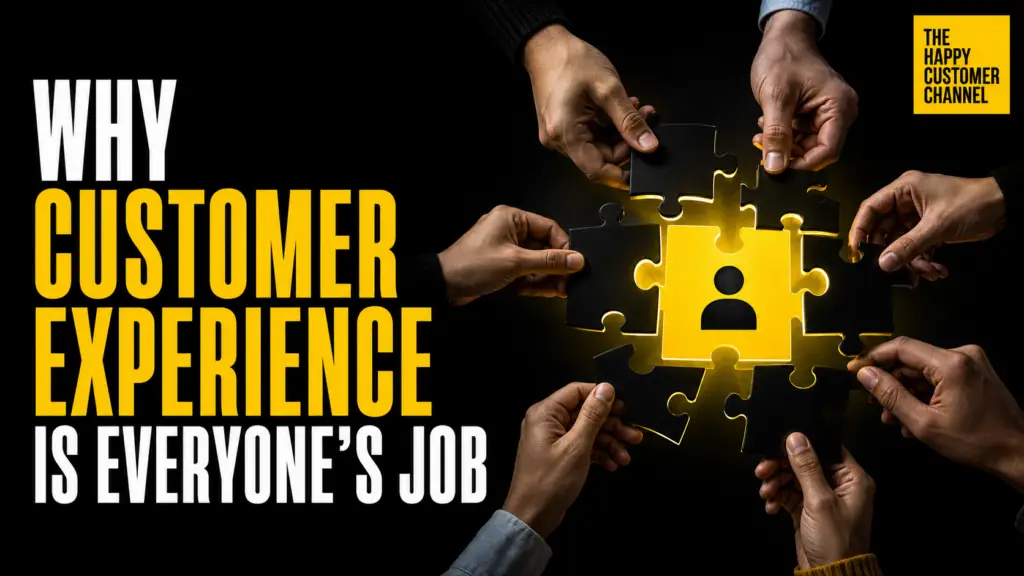
Customers don’t experience your org chart.
They experience every handoff, delay, policy, promise, and failure as one company. So when a business says it has a strong customer experience culture, but only the support team talks about customer pain, I don’t buy it.
That is not culture. That is delegation.
Here’s the reality. Customers do not care which department caused the problem. They care that the problem happened. They care that it slowed them down. They care that they had to explain the same issue three times to three different people.
And the frontline team? They usually get stuck apologizing for decisions they never made.
Customers Don’t See Departments
Customers do not separate sales, onboarding, product, billing, operations, and support. That is how we organize the business. It is not how the customer experiences it.
When sales promises one thing, onboarding delivers another, billing sends a confusing invoice, and support has no context, the customer does not say, “Looks like there was a cross-functional misalignment.” No. They say, “This company does not know what it is doing.”
That is the point most leaders miss.
One bad handoff can wipe out ten good moments. One confusing process can create doubt. One slow internal approval can make a customer feel ignored. The customer sees the outcome. They do not see the meeting behind it.
What I’ve seen over and over is this: companies love to talk about customer focus, but they design their work around internal convenience. The process works for the company. The customer just has to survive it.
That is backwards.
If the customer has to chase updates, repeat information, decode policies, or wait while teams pass responsibility around, then the experience is broken. Not because people do not care. Most people do care. It is broken because the business was not built to make ownership clear.
That is where the real work begins.
The CX Problem Usually Starts Upstream
Here’s what actually happens. A product team releases a feature with a confusing setup. Sales commits to a timeline operations never agreed to. Billing sends an invoice with line items no normal human can understand. Legal adds friction that delays activation. Then support gets the angry call.
Now everyone calls it a customer service issue.
It is not.
It is a business design issue.
Support teams are often the clean-up crew for upstream decisions. They inherit the confusion. They absorb the frustration. They become the apology engine for the company.
That is not fair. It is also not smart.
If you only measure customer experience by what happens after the customer complains, you are already late. You are managing the smoke instead of finding the fire. The fire is usually sitting in a broken process, a bad promise, a confusing product flow, or an internal rule nobody has challenged in years.
The reality is, most customer frustration is created before the customer ever contacts support.
That is why leaders need to stop asking, “How do we make support better?” as the only question. Yes, support should be strong. Yes, response time matters. Yes, empathy matters. But if every week the same preventable issues keep showing up, the answer is not more scripts. It is accountability.
Ask better questions.
Where are customers getting stuck? Where are they confused? Where are we making promises we cannot keep? Where are internal teams protecting their process at the expense of the customer?
Those answers will tell you more than a satisfaction score ever will.
Make Customer Ownership Operational
A real customer experience culture is not built through posters, slogans, or all-hands speeches. It is built into how decisions get made.
That means every team has to know how its work affects the customer. Not in theory. In practice.
Product needs to understand the support tickets created by confusing design. Sales needs to understand the churn created by overpromising. Finance needs to understand the frustration created by unclear invoices. Operations needs to understand the customer impact of delays, approvals, and handoffs.
This is where leadership matters.
You cannot just tell people, “Put the customer first,” and expect the business to change. That is a nice phrase. It is not an operating model.
Start with the customer journey. Map what actually happens, not what the slide deck says happens. Look at the points where customers wait, repeat themselves, ask for clarification, escalate, cancel, or complain. That is where the truth lives.
Then assign ownership.
Not vague ownership. Real ownership. A named team. A clear problem. A deadline. A measurable outcome.
If billing confusion drives repeat contacts, finance owns part of the experience. If onboarding delays time to value, operations owns part of the experience. If product complexity drives frustration, product owns part of the experience. If sales promises create expectation gaps, revenue owns part of the experience.
This is not about blame. Blame makes people defensive. Ownership makes the business better.
What I’ve seen is that the best companies do not treat customer feedback like a support report. They treat it like business intelligence. They bring it into leadership meetings. They share it with teams that never speak directly to customers. They connect pain points to real decisions.
That is how you build accountability.
And accountability changes behavior.
People stop asking, “Did we complete our task?” and start asking, “Did we improve the customer’s outcome?” That shift is everything. Because the customer does not care that the task was completed if the experience still feels broken.
Final Thoughts
If only one team owns customer experience, the customer pays for everyone else’s disconnect.
A true customer experience culture shows up when every team can answer one simple question: “How did our work make the customer’s life easier today?”
That question cuts through the noise. It exposes the gaps. It forces the business to stop hiding behind departments and start owning the experience as one company.
At the end of the day, customers remember how easy or painful you made it to do business with you. That is the standard.
Common Questions
Isn’t customer experience mainly the customer service team’s responsibility?
Listen… customer service plays a major role, but they are not the whole experience. They handle the visible pain. They do not always create it. A customer may call support because the invoice was confusing, the product was hard to use, or sales set the wrong expectation. That means the issue started somewhere else. If support is the only team accountable, you are fixing symptoms while the source keeps creating new problems.
How do we get teams that never talk to customers to care?
Here’s the reality: people care more when they can see the impact of their decisions. Bring real customer feedback into product, finance, operations, and leadership meetings. Show the actual complaints. Show the repeated friction. Show what it costs in refunds, churn, escalations, and wasted time. Once teams see the connection between their work and customer pain, the conversation changes fast.
What is the first step in building this kind of culture?
What I’ve seen is that the first step is mapping the real customer journey. Not the ideal version. The real version. Where do customers wait? Where do they get confused? Where do they have to follow up? Once you see the friction clearly, assign ownership to the teams that can actually fix it. Without ownership, the map is just another document.
How do we know if customer experience is becoming everyone’s job?
At the end of the day, you will see it in behavior. Teams will bring up customer impact before decisions are final. Repeat issues will start to drop. Handoffs will get cleaner. Leaders will ask better questions than, “Did we hit the internal target?” They will ask, “Did this make the customer’s life easier?” That is when you know the culture is becoming real.