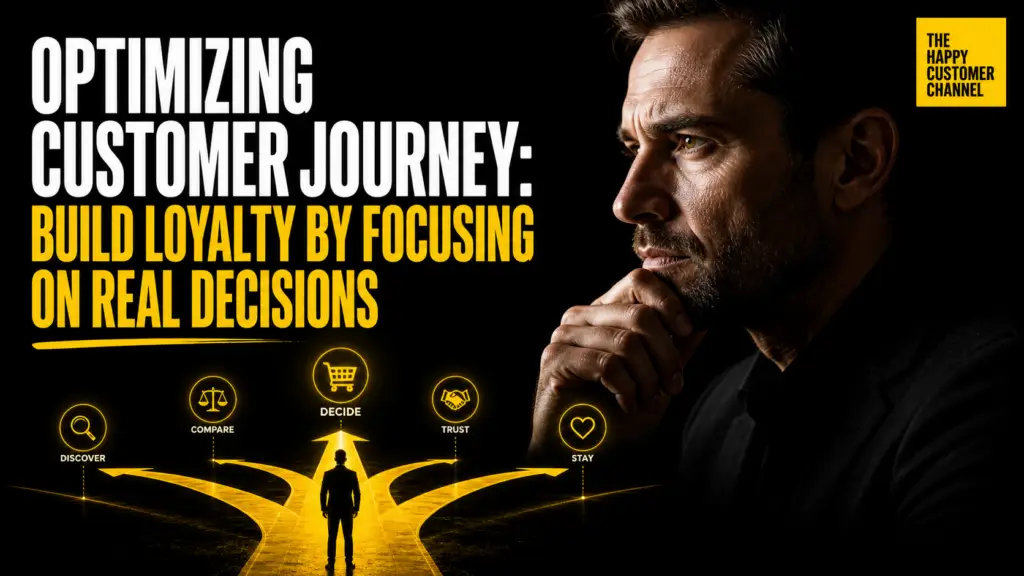
Are you letting analytics dictate your customer journey, or real-world decisions? Every wasted step is a wasted dollar—and customers don’t forgive wasted time. Too many brands are optimizing customer journey maps for optics, not for what moves the needle. The result? Friction, wasted investment, and another lost customer. Today, we’re talking about optimizing customer journey with ruthless focus on real decisions. This isn’t theory. It’s the hard reality of retention, growth, and trust.
Stop Optimizing for the Wrong Things
Let’s cut to the chase. You’re not in business to produce the prettiest journey map in the room. You’re in business to keep customers, drive growth, and, above all, earn trust. But here’s where most customer experience teams go sideways—they obsess over vanity metrics, surface-level touchpoints, and perfect flows. I’ve seen it a hundred times. Busywork gets rewarded. Real results? Not so much.
Sound familiar? Maybe you’re tracking NPS as your North Star. Or stuck fine-tuning checkout screens that don’t even matter to your churn problem. Meanwhile, the real decision moments—where customers actually choose to stay, upgrade, or leave—get glossed over. That’s what ruins retention faster than any website bug.
If you optimize for what looks good, not what matters, you will fail. It’s a common trap, and it’s usually caused by a lack of operational standards. Want proof? Go deeper into why most journey mapping fails in real-world CX: CX Strategy Fails Without Operating Standards.
Use the 3D Framework for Real-World Journey Optimization
Here’s the fix. You need a framework built on what really counts—the moments where decisions get made. I call it the “3D” approach. It’s simple. It’s brutal. It works.
- Discover: Start by pinpointing the actual decision moments. Where do customers choose: to buy, renew, refer you, or escalate a complaint? If you’re not clear on this, you’re already losing. Look at real data: churn events, escalations, upsell misses, renewal dips. Talk to frontline staff. Dig into customer conversations. Forget about endless touchpoint mapping that doesn’t translate to a binary decision.
- Diagnose: Now dive deep. For each decision moment, ask: “What forces drive the choice?” Is it complicated onboarding? Unclear pricing? Support friction? Don’t guess. Use lost customer interviews, survey dropoffs, call logs. Find what’s really influencing action or inaction.
- Design: Only now do you rebuild. Focus every process, bit of technology, and internal script directly on optimizing those exact decision points. Cut the fluff. If most churn happens during onboarding, put 90% of your firepower there. If renewals dip at pricing time, overhaul that moment first. And don’t just watch overall journey satisfaction—measure conversion, churn, speed at each critical choice.
Here’s the key: optimizing customer journey isn’t about adding more. Sometimes “less” is the move. Strip away distractions. Keep customers locked into what matters. Real journey optimization means saying “no” to wasted steps and “yes” to decisions that fuel your bottom line.
Leadership Discipline and Trust: The Real Outcome
When leaders get disciplined about optimizing customer journey around real decisions, everybody wins. Customers notice. They feel heard, not handled. Trust grows, and loyalty follows. But this takes focus. Most operators throw budget and bodies at every minor feedback blip, then wonder why nothing sticks. The reality? Customers reward ruthless prioritization—and spot when you’re just checking boxes.
Want higher retention, more referrals, and a business that outlasts the fads? Make optimization a daily leadership discipline. Lead teams to confront every assumption. Measure what actually moves the customer to act. And cut the rest.
This is what we live for at The Happy Customer Channel. Operator-level CX. No fluff. No buzzwords. Only what delivers real business results and repeat loyalty.
Final Thoughts
Optimizing customer journey is not an annual project. It’s not about the tech stack or the prettiest chart. It’s a relentless discipline. Get clear on what decisions matter. Build around them. Customers will see it, feel it, and reward you. Don’t coast. Don’t compromise. Focus on real decisions or fall behind—those are your choices.
Want more real-world CX strategies that cut through the noise? Subscribe to our newsletter for weekly, no-fluff guidance direct to your inbox.
Common Questions
How do I identify the “real decisions” that shape my customer journey?
Listen—don’t waste time with guesswork or copying someone else’s map. Start by digging into your churn data, your complaint logs, and every point where customers drop or escalate. Look for the moments they hit pause or call you out. Get input from your frontline people; they see the real story. Forget mapping every click—go after the big decisions. If a stage doesn’t change the customer’s fate, you can safely ignore it.
Does optimizing the customer journey always mean adding more touchpoints or technology?
Here’s the reality: More isn’t better. I’ve watched companies burn millions layering on tech and channels that just muddy the experience. Sometimes, optimizing means cutting out the clutter—removing friction, not adding features. Double down where customers actually struggle to decide, and ruthlessly trim the rest. Less noise, more signal. Simple wins.
How do I measure the impact of customer journey changes?
Don’t hide behind vanity metrics. At the end of the day, you need to tie every change back to a hard outcome—conversion, reduced churn at a specific step, or a faster resolution on escalations. NPS is fine, but it won’t save your renewal numbers if you’re ignoring actual behaviors. Measure the before and after at decision points, not just overall satisfaction. That’s how operators prove ROI.
What if my team disagrees on what the “real decision moments” are?
Get everyone in a room—seriously. Bring support, sales, ops, the actual frontline. Lay out the data. Don’t settle for opinions. What I’ve seen work best is mapping customer pain, then testing your hypotheses. Validate with customer calls and lost deal reviews. When people see undeniable data, the debate cools fast. Cross-functional buy-in wins every time.