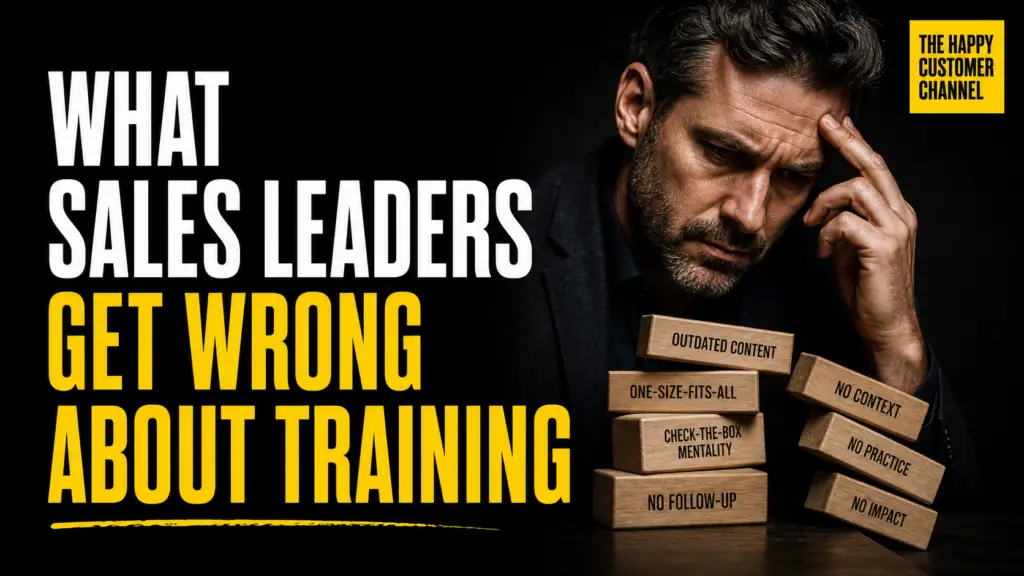
Most sales training does not fail in the classroom. It fails the Monday after training, when everyone goes back to the same meetings, the same pressure, and the same old habits.
That is where sales training effectiveness gets exposed. Not in the workshop. Not in the feedback survey. Not in the completion report. It gets exposed in the next discovery call, the next pipeline review, the next deal that stalls, and the next manager who lets poor execution slide.
Here’s the reality. Sales leaders often treat training like an event. They block the calendar. They bring in the expert. They roll out the slides. Then they assume the team is better because the team attended. That is not leadership. That is hope with a calendar invite.
Training Is Not the Finish Line
Training creates awareness. That matters. But awareness is not adoption. A rep can understand a framework and still not use it when a real buyer pushes back. A team can nod along in a session and still run the same weak discovery calls the next day.
What I’ve seen is this. Companies measure the easy things. Attendance. Completion. Satisfaction. Did people show up? Did they like the trainer? Did they rate the session a 4.7 out of 5? Fine. But none of that proves the business changed.
The real question is tougher. Did the rep ask better questions? Did they qualify harder? Did they stop chasing bad-fit deals? Did they create stronger next steps? Did the customer experience improve because the seller became more useful, more prepared, and more disciplined?
That is the work. And that work happens after the training room.
Too many sales organizations confuse information with transformation. They believe if the team hears the message, the team will execute the message. That is not how sales works. Sales is pressure. Sales is emotion. Sales is rejection. Under pressure, people do not rise to the level of the workshop. They fall back to the level of their habits.
If leaders want different behavior, they have to build different habits. That means training must connect to live calls, real accounts, active deals, and actual buyer conversations. Otherwise, it becomes a nice day away from the grind. People feel inspired. Then the pipeline still looks the same.
Managers Make or Break Adoption
Here’s what actually happens in many sales teams. The company trains reps on better discovery. Then the manager runs a pipeline meeting and only asks, “When is it closing?” The company trains reps to qualify better. Then leadership celebrates pipeline volume, even when half of it is garbage. The company trains reps to slow down and understand the buyer. Then the manager pushes them to send a proposal too early.
That is the disconnect. The training says one thing. The operating rhythm says another. Guess which one wins?
The operating rhythm always wins.
Real sales training effectiveness is driven by what managers inspect, coach, and reinforce every week. Not once a quarter. Not only after a bad month. Every week. Reps pay attention to what their manager cares about. If the manager cares about the new behavior, it becomes important. If the manager ignores it, the rep ignores it too.
This is why frontline managers are the conversion point. They turn concepts into standards. They translate training into field execution. They hear the calls. They review the deals. They see where reps cut corners. They know when a seller is using the language but not living the discipline.
But many companies skip this part. They train the sellers and forget to train the managers on how to coach the sellers. That is a costly miss. A rep cannot be expected to sustain a new habit if the person managing them is not equipped to reinforce it.
Manager reinforcement is not complicated. But it does require discipline. Listen to calls. Coach one behavior at a time. Ask better questions in deal reviews. Tie the training language to real opportunities. Praise the right execution when you see it. Correct the old habits when they show up.
Do that consistently, and training starts to stick. Ignore it, and the team will drift right back to comfort.
Stop Buying Training Without an Operating Plan
Before leaders buy another program, they need to slow down and ask better questions. What behavior are we trying to change? Where does that behavior show up in the sales process? Who will coach it? How often will we inspect it? What proof will tell us it is working?
If those questions are not answered, training becomes activity without accountability. It looks good. It feels responsible. It gives leadership something to point to. But it does not move the business.
I have seen teams spend heavily on training and still struggle with the same core issues six months later. Weak discovery. Poor follow-up. Bloated pipeline. Bad forecasting. Too many demos with unqualified buyers. Too many proposals sent without real commitment. That is not a training content problem. That is a leadership operating problem.
The best sales organizations do not treat training as a separate initiative. They wire it into how the team runs. If the training is about discovery, the call review should focus on discovery. If the training is about qualification, the pipeline review should pressure-test qualification. If the training is about negotiation, managers should coach live deals before concessions are made, not after margin is gone.
That is how behavior changes. Not through more content. Through repetition, inspection, and consequence.
And yes, consequence matters. Not punishment. Standards. If the company says qualification matters, but reps are allowed to keep weak deals in the forecast, the standard is fake. If the company says customer outcomes matter, but rewards sellers for pushing bad-fit deals, the standard is fake. Teams can smell fake standards immediately.
Leaders have to make the new behavior impossible to ignore. Put it in the one-on-one. Put it in the pipeline review. Put it in the call coaching. Put it in the forecast conversation. Put it in how wins are celebrated. Put it in how misses are diagnosed.
That is not extra work. That is leadership work.
Final Thoughts
Sales training effectiveness is not created by better slides, louder speakers, or longer workshops. It is created when leaders stop outsourcing behavior change and start owning the environment where behavior either survives or dies.
If the team forgets the training, look at the system around them. Look at what managers reinforce. Look at what leaders reward. Look at what gets tolerated. That is where the truth is.
Common Questions
Why does sales training feel useful but still fail to improve performance?
Listen, a good training session can absolutely create energy. People leave motivated. They say the right things. They may even believe they are going to change. But here’s the reality: motivation wears off fast when the daily pressure comes back. If managers do not reinforce the behavior, the old habits win. Training feels useful because people learned something. Performance changes only when they repeatedly do something different.
How do we know if our sales training is actually working?
What I’ve seen is that leaders need to stop relying on attendance reports as proof. Attendance tells you who was in the room. It does not tell you who improved. Look at call quality, qualification discipline, conversion rates, follow-up strength, pipeline accuracy, and deal movement. Watch what reps do with real buyers. At the end of the day, the field tells the truth.
Should sales managers be involved before and after training?
Yes. No debate. If managers are not involved before training, they do not know what behavior they are expected to reinforce. If they are not involved after training, the team has no real coaching bridge back to the field. Here’s what actually happens when managers sit it out: reps treat the training like a suggestion. Managers turn it into a standard.
How often should sales training be reinforced?
Weekly. Not through another formal class every week. That is not the point. Reinforcement should happen in call reviews, deal reviews, one-on-ones, team meetings, and live coaching moments. Listen, if the behavior matters, it has to show up in the rhythm of the business. If it only shows up once a quarter, it does not matter enough.