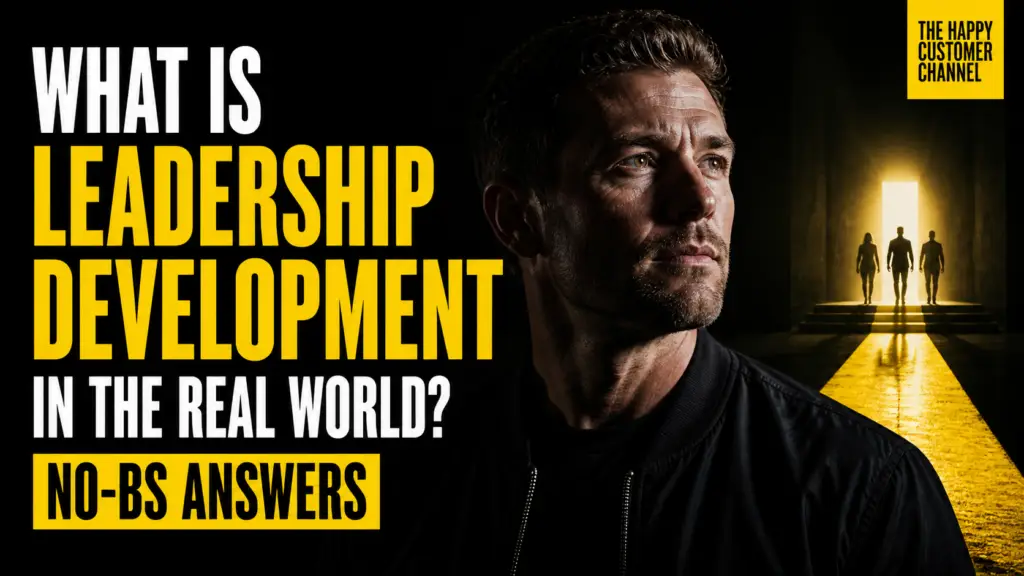
Ask ten executives, “What is leadership development?” Get ten different answers—and most won’t move the needle. That’s a problem. Because if your answer to what is leadership development doesn’t actually change behavior, build trust, or move business outcomes, you’re burning time, money, and reputation. Why do so many companies still get it wrong? Let’s get real and clean up the mess once and for all, with zero fluff.
Why Most Leadership Development Is a Mirage
Let’s step into the fire. Most leadership development programs? Smoke and mirrors. They sound great in annual reports and look good on HR dashboards. But let’s be honest—how many actually show up where it counts? On the floor. At the front line. In that moment when a customer’s trust hangs in the balance.
Here’s what really happens. Generic workshops. PowerPoint decks. “Leadership competencies” that read like a fortune cookie. You’ve probably watched high-potential talent get paraded through these programs… only to land right back in old habits. Why? Because academic leadership doesn’t survive first contact with real pressure. Culture can’t be built in a classroom.
In my years running ops and observing high-growth teams, I’ve seen this pattern everywhere. Development that skips accountability is a feel-good exercise—not a catalyst for change. The organizations that win don’t “train” leaders—they forge them with real stakes, daily visibility, and a relentless focus on impact. They force the issue: Does this program actually change team behavior and business results? If not, it’s leadership theater. No operator has time for that.
If you want to see the leaders who drive lasting culture, start by cutting the noise. Focus on observable changes. If your team can’t name what their leaders actually do differently after the program, you didn’t develop anyone.
Why start here? Because diagnosis comes before prescription. If you don’t admit what’s broken, you’ll stay broken. The operators, founders, and customer leaders I work with demand better. So should you. Don’t just take my word for it—see how real-world leaders attack this problem on The Happy Customer Channel if you want even more tactical evidence.
Real-World Leadership Development—A Practical Framework
Now we answer the real question: what is leadership development that actually delivers? Boil away the buzzwords. It comes down to three things: discipline, trust, and outcomes that show up on the ground.
I use what I call The Leadership Discipline Loop. It’s brutal in its simplicity—because anything with friction or fluff gets ignored. Here’s how you operationalize it:
- Exposure: Take your leaders—frontline or exec—and put them in real, pressure-tested business scenarios. Not simulations. Not staged group hugs. Real situations where customer trust and team outcomes are at stake. Leadership is an action sport.
- Feedback: Measure trust and conduct where it matters. 360s are fine—but get actual customer and team input, weekly. Skip the sugar-coating. Show trends. Show consequences.
- Accountability: Tie leadership actions to real results—metrics, team voice, and customer outcomes. Everyone on your team should know: if you want to lead, you get measured for impact, not intention.
Simple checklist? Run through this every quarter:
- Where did your leaders demonstrate discipline under fire? (Be specific)
- How did they earn or lose team trust—in actual events?
- What measurable result changed because your leader changed?
- Who called it out (not anonymous surveys—real names, real feedback)?
- What story from the quarter would you tell a new hire to illustrate great leadership?
Leadership development without this level of rigor is just talk. The point isn’t perfection. It’s visibility and rapid correction. If you can’t spot growth—or backsliding—fast, you aren’t developing leaders. You’re writing scripts for a play nobody wants to watch.
And before you ask—yes, this works at every level. The best board members I’ve seen hold each other to the same standards they expect from a shift manager. Universal. Non-negotiable.
Culture, Trust, and Outcomes—The Non-Negotiables
Let’s get something straight. Culture isn’t a slogan or a perks package. It’s the lived discipline your leaders enforce, especially when it’s inconvenient. Your customer, your team, your outcomes—they all hang on this.
Trust is the core currency. You either strengthen it or drain it with every single decision. Leaders who cut corners, hide from the truth, or play hero on their own? They kill trust—and culture with it. But those who seek the hard conversations, take visible accountability, and teach by doing? Their teams run harder and stay longer. Their customers come back.
Discipline isn’t about punishment. It’s about predictable follow-through. Start-ups that lack discipline, die young. Enterprise teams without discipline rot from within. I’ve seen both. You can’t scale what you can’t trust. You can’t trust what you can’t measure.
So what does world-class leadership development actually give you? Teams where failure gets surfaced, not buried. Customers who stick because the experience feels real and owned. Numbers you can defend at the board table and in a focus group.
Operators who nail this aren’t afraid of feedback. They make it part of the ritual. They treat trust and discipline as the scoreboard. Their culture scales—on purpose, not by accident.
Final Thoughts
If you want real leadership development, stop tolerating leadership theater. Make trust, discipline, and results your true north—and demand visibility at every turn. Development is not a program. It’s a sequence of high-stakes reps. That’s where CSAT climbs. That’s where revenue moves. That’s where your best people stay for the long haul.
If you want regular, no-BS leadership tactics—proven by real operators—not consultants—sign up for the newsletter here and sharpen your edge.
Common Questions
How do I know if my current leadership development program is actually working?
Listen—don’t just check attendance lists. Are people actually changing? Do you see different behaviors when the pressure hits? What I’ve seen is, if your team can’t point to specific, recent actions that built trust or drove results, your program is just noise. Ask for hard examples—out loud—in the room. No evidence? No progress.
What skills should we focus on when developing frontline vs. executive leaders?
Here’s the reality—leadership is contextual, but the core muscles are the same: discipline, trust, and real accountability. Frontline leaders need to be masters of action and feedback in the moment. Executives? They need to operationalize culture at scale and model the same behaviors—loudly—so nobody misses the point. Don’t split hairs on theory. Focus on what moves people and numbers. Period.
How can I measure if leadership development is impacting our customer trust and business results?
What I’ve seen work: tie leadership actions to real metrics and stories. Did customer complaints drop? Did team survey trust scores rise after a development push? Are more customers recommending you? Collect proof every quarter. If you aren’t seeing shifts in your numbers—or hearing new voices giving real feedback—you’re not moving the needle. Visibility is power.
My team resists “leadership training”—how do I make it stick in our culture?
At the end of the day, nobody loves lectures—especially high performers. Make it real. Build development into daily workflows and team rituals. Expose leaders to live situations, then follow up hard with feedback and accountability. When your team sees leaders changing for the better—openly—they buy in. Leadership development should feel like an advantage, not a punishment.