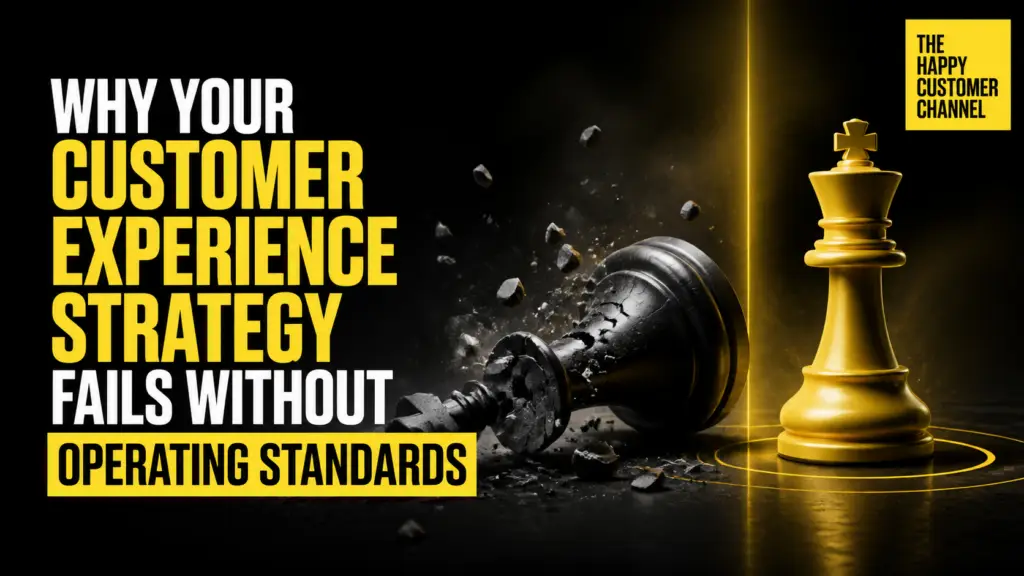
Big strategies don’t save you when a customer is angry at 9:30 p.m. and your team misfires. Thought-provoking customer experience strategy slides look impressive in boardrooms, but customers never get to see those decks. They only see what your team actually does. Here’s the gut punch: most customer experience strategies collapse the moment your company scales—because nobody wrote down what “great” looks like daily. Why do so many ambitious CX plans fall apart when growth happens?
The False Security of Big Ideas
Every founder and CX operator talks about customer experience strategy. It’s everywhere—memos, values posters, kickoff meetings. But tell me, what does “put customers first” actually look like on a Tuesday at 3:45 p.m. when your busiest customer calls with a weird request? If you rely on passion and good intentions, good luck scaling past your first dozen people. Here’s the hard truth: brilliant ideas are just noise without real operating standards. You’re not building consistency—you’re inviting chaos. Fuzzy slogans don’t help your team earn five-star reviews or handle tricky service moments. Without explicit, lived protocols, “CX” is just corporate theater. And it usually unravels exactly when the stakes get highest—when you’re growing fast.
Execution Lives and Dies on Operating Standards
You want a customer experience strategy that actually sticks? Stop making it poetic. Make it operational. Real standards look like this: documented ways to greet, serve, recover, and learn from customers. Checklists. Playbooks. Who owns what, when, and how. Rituals for feedback. Standard operating procedures for escalation. This is the DNA of any durable CX system.
Let’s be blunt. Ownership does not trickle down after a summit meeting. You need to hand it out every week—with onboarding, with daily standups, with consistent reviews of what works and what fails. Companies that create strong trust and loyalty are not led by dreamers alone. They are led by operators obsessed with elimination of guesswork. The difference-makers have repeatable ways to deliver—every time, no matter who’s wearing the apron or answering the chat.
Here’s a practical standard-setting checklist for any operator who actually wants a working customer experience strategy:
- Document the non-negotiables for every key customer interaction.
- Assign clear ownership of each stage (don’t spread accountability thin).
- Embed routines—daily, weekly, monthly—to review and reinforce.
- Give your people escalation code words and real authority to fix what breaks.
- Close the loop after every service incident: what happened, why, and what changed?
If any step is missing, you’re tempting fate. No amount of vision will save a company with weak standards at scale.
Recovery and Feedback Loops—Your Only Shock Absorbers
Every CX operator learns this lesson the hard way: your brand is not how you perform on your best days. It’s how you fix things when you screw up. That’s where operating standards really prove their worth. Is every customer-facing team member trained and empowered to recover from mistakes—fast, without passing blame? If not, you haven’t built a real system—you’ve built hopes and prayers.
Feedback loops aren’t sexy, but they separate the amateurs from the pros. Winners don’t just say “We’ll do better next time.” They dig into failures. They collect, share, and act on feedback. Not by accident—by process. After every service issue, who’s debriefing? Where’s the improvement logged? Who owns the follow-up?
The best operate with muscle memory. Recovery and feedback are baked into the culture, not wishful thinking. That turns scattered good intentions into unbreakable, customer-winning habits.
Final Thoughts
Your customer experience strategy is only as strong as your weakest operating standard. If you haven’t turned your best CX ideas into routines and rituals—if you can’t point to a playbook, a process, a documented line of accountability—then you aren’t building loyalty, you’re gambling with every new hire and every new customer. Build systems, not slogans. Consistency, not charisma. That’s what wins trust at scale.
Want more practical frameworks and operator-tested playbooks for building CX that actually works? Join The Happy Customer Channel newsletter and upgrade your CX operating system every week.
Common Questions
What’s the difference between a customer experience strategy and operating standards?
Listen, a customer experience strategy is just your destination—the big vision, the promise you want to keep. But operating standards? That’s your step-by-step route. That’s what your people actually do with customers, every time, every channel, no matter what. Companies die on this hill all the time. At the end of the day, it’s the standards, not the slogans, that make your vision real. No clear standards? No repeatable results. Period.
Why do customer experience strategies fall apart when a company grows?
Here’s the reality: what works as a small team—energy, founder passion, tribal knowledge—it breaks fast. Growth multiplies hand-offs, adds complexity, and introduces new ways for things to go sideways. If you haven’t nailed every crucial behavior into a repeatable process, inconsistency creeps in. That’s when CX goes south. Scale exposes every shortcut and every assumption you made when you were small. You can’t wing it past 20 people—and certainly not at 100 or 1,000.
How can I ensure my team takes real ownership of CX outcomes?
Ownership isn’t a pep talk. It’s clarity in action. What I’ve seen is, the teams that win have built-in routines: every person knows exactly what they own, how to execute, how to escalate, and what success looks like. You want ownership? Assign measurable routines. Make outcomes visible. Review often. Don’t just tell people to “own it”—engineer the job so they can’t hide from results. When there’s nowhere to hide, accountability happens naturally.
How do feedback loops actually improve customer experience?
If you’re not reviewing feedback religiously, you’re leaving money and loyalty on the table. Feedback loops are your built-in correction engine. Every slip, every service miss—that’s free consulting. The best operators collect it, distill it, act on it, cycle it back into training and process. Amateurs handle complaints reactively. Pros treat feedback as prized assets. That’s how you get better, faster—no matter how big you are.