
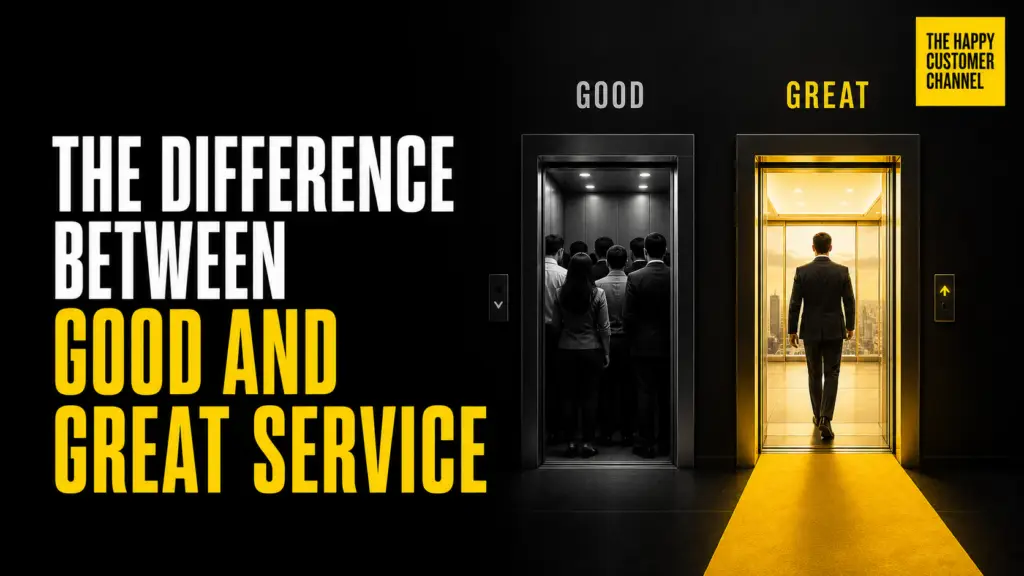
Good service keeps the customer from leaving angry. Great service gives them a reason to come back.
That difference matters. A lot. Because most businesses are not losing customers because their people are rude. They are losing customers because the experience feels heavy, confusing, slow, or disconnected. That is where service quality improvement either becomes real work or just another phrase in a meeting.
Here’s the tension. A company can hit its response-time targets and still frustrate people. It can close tickets quickly and still make customers feel ignored. It can train employees to be polite and still fail to create trust.
Good service solves the issue. Great service owns the outcome.
Good Service Follows the Process
Good service is not bad. Let’s be clear about that. Good service matters. It means your team answers the phone, responds to emails, follows policy, gives accurate information, and resolves the stated problem.
That is competence. And competence is necessary.
But competence is not greatness. It is the floor.
What I’ve seen over and over is that companies mistake “we did what we were supposed to do” for “we gave the customer a strong experience.” Those are not the same thing. A customer can get the correct answer and still feel like dealing with you was a chore.
Here’s what actually happens. The customer calls in. They explain the issue. The employee checks the system. The employee follows the script. The employee gives the right answer. The ticket gets closed.
Looks clean on the dashboard.
But what did the customer experience?
Maybe they had to repeat themselves twice. Maybe they were transferred without context. Maybe nobody explained what would happen next. Maybe the policy made sense internally but felt ridiculous externally. Maybe the employee sounded polite but powerless.
That is the gap. And that gap is expensive.
Good service usually protects the company’s process. Great service protects the customer’s confidence.
There is a difference.
Great Service Takes Ownership
Great service does not make the customer manage your business for you.
That is the line.
If a customer has to chase updates, repeat the story, connect your departments, decode your process, or remind your team what was promised, you are not delivering great service. You are creating work for the customer.
And customers remember that.
They may not remember every detail. They may not remember the name of the system that was down or the exact reason for the delay. But they remember how it felt. Easy or exhausting. Clear or confusing. Human or mechanical.
Great service removes burden. It anticipates the next question. It explains the next step. It tells the customer what is happening before the customer has to ask. It gives people a sense that someone is actually in control.
This is where ownership shows up.
Ownership sounds like this: “I’m going to stay with this until it’s resolved.” It sounds like: “You don’t need to call another department. I’ll coordinate that.” It sounds like: “Here is what will happen next, and here is when you’ll hear from us.”
Simple. Direct. Powerful.
Great service is not always dramatic. It is not always a big recovery moment. Most of the time, it is a series of small signals that tell the customer, “We’ve got you.”
That matters because customers do not want perfection as much as businesses think they do. They want confidence. When something goes wrong, they want to know the company will not disappear, deflect, or make them fight for basic help.
That is the difference between a transaction and a relationship.
The Gap Is Where Improvement Lives
If you want real service quality improvement, stop looking only at the averages.
Average response time. Average handle time. Average satisfaction score. Those numbers have value. But they also hide the truth. Averages can make leadership feel safe while customers are still dealing with friction every day.
The better question is: where do customers lose confidence?
Look at the handoffs. Look at the repeat contacts. Look at the moments where employees say, “That’s our policy.” Look at the issues that technically get resolved but still leave the customer annoyed. Look at the places where your frontline team knows the process is broken but has learned to work around it.
That is where the truth lives.
Service improvement is not just a training problem. Sometimes it is an authority problem. Sometimes employees know the right thing to do, but the system will not let them do it. Sometimes they are told to deliver great service while being measured on speed alone.
You cannot ask people to build trust and then punish them for taking the time to do it.
Scripts have their place. Standards matter. Consistency matters. But judgment matters too. A script can guide the conversation. It cannot replace ownership. It cannot read the room. It cannot sense when a customer is confused, upset, or losing patience.
The best service teams do both. They have standards, and they train judgment. They know what must be consistent, and they know where a human being needs room to act.
That is where good becomes great.
Final Thoughts
Customers do not care how complicated your internal process is. They care whether dealing with you feels worth it.
That is the standard. Not how many tickets you closed. Not how fast the queue moved. Not how polite the script sounded. The real measure is whether the customer felt understood, protected, and moved forward.
At the end of the day, service quality improvement is not about looking better on paper. It is about becoming easier to trust in real life.
Common Questions
How do we know if our service is good but not great?
Listen… if customers are satisfied but not loyal, you may be delivering good service, not great service. They got what they needed, but they did not feel anything strong enough to bring them back. What I’ve seen is that good service produces acceptance. Great service produces confidence. Look for signs like repeat complaints, customers chasing updates, and people saying, “Everything was fine,” but never returning. “Fine” is not the goal.
Is great service just about faster response times?
No. Speed matters, but speed is not the whole game. Here’s the reality: a fast answer that does not solve the real issue just creates faster frustration. Customers want progress, not motion. If your team replies quickly but the customer still has to explain everything again, follow up three times, or wait for another department, that is not great service. That is a fast handoff.
How can we improve service quality without hiring more people?
Start by removing unnecessary customer effort. Listen, many service problems are not staffing problems first. They are friction problems. Fix the repeat questions. Clarify the handoffs. Give customers proactive updates. Empower frontline employees to solve common issues without waiting for five approvals. You may still need more people later, but first stop wasting the capacity you already have.
How do we keep service consistent while still letting people use judgment?
Here’s what actually works: define the non-negotiables, then train people on real situations. Consistency should protect the customer experience, not turn your team into robots. Give employees clear standards for accuracy, tone, follow-up, and ownership. Then teach them how to think when the situation does not fit the script. At the end of the day, customers can feel the difference between someone following a line and someone taking responsibility.