
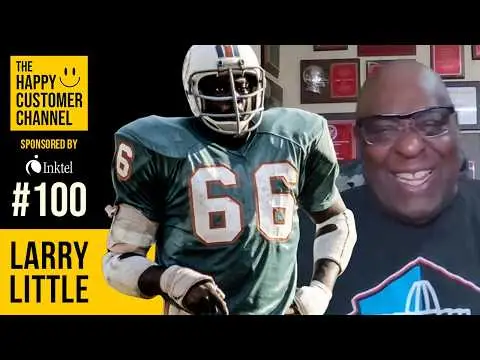
FULL EPISODE HERE
From Rejection to Championship Culture: Leadership Lessons from Larry Little and the 1972 Miami Dolphins
What does it take to turn overlooked talent into championship performance? In this episode, Hall of Famer Larry Little shares a leadership story shaped by poverty, segregation, rejection, and ultimately, elite execution at the highest level of professional football. His journey from being underestimated to becoming a key part of the undefeated 1972 Miami Dolphins offers practical lessons for business leaders on confidence, culture, discipline, and accountability. The central idea is simple but powerful: great outcomes are rarely accidental—they come from self-belief, strong systems, and leaders who set uncompromising standards.
What This Episode Covers
This conversation goes far beyond football. Larry Little reflects on how adversity shaped his mindset, how disciplined leadership transformed team performance, and what business leaders can learn from championship environments that consistently outperform expectations.
- How self-belief helped Larry Little overcome rejection and limited expectations
- Why discipline and detail separate good teams from great ones
- The leadership difference between loose management and high-performance coaching
- How Don Shula created buy-in, accountability, and consistency
- Why overlooked talent thrives in the right system
- What Larry Little learned later as a coach about trust and delegation
- How strong execution can overcome limited resources
Key Insights
Self-Belief Is the First Competitive Advantage
Larry Little’s story begins with a reality many professionals know well: being underestimated. He faced poverty, segregation, and repeated rejection, yet he refused to let external doubt define his ceiling. For business leaders, this is a critical lesson. Confidence is not just a personality trait—it is a performance advantage. Before markets, managers, or customers validate someone’s potential, they often need to maintain belief in themselves long enough to keep improving, competing, and staying visible when opportunities appear.
His perspective is captured clearly in statements like, “Nobody had confidence in me but me,” and, “I would let nobody take the confidence of myself away from me.” In business, that mindset matters most when recognition is delayed. High performers often separate themselves not because they receive early support, but because they continue executing without it.
Elite Performance Requires Discipline, Not Just Motivation
One of the strongest contrasts in the episode is the difference Larry Little describes between relaxed management and Don Shula’s disciplined coaching system. In his words, the shift was “like night and day.” Shula’s approach centered on operational rigor: punctuality, precision, accountability, and an expectation that mistakes should be minimized through preparation.
This is directly relevant to business. Motivation can create bursts of effort, but discipline creates repeatable results. Teams do not become elite through energy alone. They improve when expectations are clear, standards are non-negotiable, and execution is consistent. Organizations that want sustained performance need to build systems that reduce errors, tighten communication, and make excellence a daily habit rather than an occasional event.
Leadership Creates Buy-In Through Standards and Consistency
Another major lesson from the episode is that leadership is not about charisma alone. It is about creating an environment where people believe in the system and trust the standard. Larry Little notes, “We had bought into what the coaching staff presented to us.” That buy-in was not generated by slogans. It came from clarity, discipline, and a coaching staff that made expectations tangible.
For executives and team leaders, this is a useful reminder: alignment does not happen because people are told to care. It happens when leaders define what winning looks like, enforce it consistently, and create confidence that the system works. When teams believe the process is sound, they commit more deeply to execution. Strong cultures are built on trust in the operating model, not just trust in a leader’s personality.
Underestimated Talent Can Become a Strategic Advantage
Larry Little’s career demonstrates that talent is often misjudged when viewed without context. People with high potential are frequently overlooked because they do not fit conventional expectations, come from nontraditional backgrounds, or have not yet been placed in environments that develop them properly. Once those individuals enter the right system, their value can rise quickly.
For businesses, this has direct implications for hiring, development, and retention. Organizations that only chase obvious credentials often miss resilient, adaptable, high-upside talent. The smarter approach is to identify people with drive, coachability, and commitment—then place them in a culture that sharpens performance. In many cases, overlooked talent becomes a disproportionate asset because it combines hunger with opportunity.
Adversity Can Build Long-Term Leadership Strength
This episode also reinforces that hardship, while difficult, can shape durable leadership traits. Larry Little’s early challenges forged resilience, perspective, and determination. He did not frame adversity as a reason to lower expectations. Instead, he used it as fuel. That mindset is valuable for leaders navigating uncertainty, setbacks, or constrained growth periods.
Adversity often strips away comfort and forces clarity. It teaches problem-solving, emotional control, and persistence. Leaders who emerge stronger from difficult environments tend to be more grounded, more credible, and more effective at guiding others through pressure. In business, resilience should not be treated as a soft trait—it is a practical capability that sustains performance when ideal conditions do not exist.
Resource Constraints Do Not Excuse Poor Execution
One of the most important business lessons in the episode is that limited resources do not prevent strong results when execution is disciplined. Larry Little’s later coaching experience highlights this clearly. He speaks to the importance of accountability, trust, and doing the job effectively even without ideal conditions.
Many organizations use budget, staffing, or market conditions to explain underperformance. While constraints are real, they do not automatically justify weak standards. Great leaders focus first on what can be controlled: preparation, communication, role clarity, effort, and decision-making. Businesses that execute well under pressure often outperform better-resourced competitors that operate with less discipline.
Great Leaders Empower Others Instead of Overcontrolling
A particularly useful leadership lesson comes from Larry Little’s coaching philosophy: “Don’t overcoach. Let your coaches coach.” This principle applies directly to management. Strong leaders are not effective because they insert themselves into every function. They are effective because they hire capable people, define accountability, and allow others to own their roles.
Micromanagement weakens initiative, slows decisions, and creates dependency. Empowerment, when paired with clear standards, creates stronger teams. Larry Little’s approach reflects a mature leadership model: trust the right people, correct issues privately, and keep the senior leader focused on core decisions rather than unnecessary interference. In business, this is often the difference between a scalable organization and one trapped by bottlenecks at the top.
Championship Cultures Focus on Process, and Results Follow
The undefeated 1972 Miami Dolphins remain one of the strongest examples of sustained team performance. But this episode makes clear that extraordinary outcomes were the byproduct, not the primary obsession. The team’s edge came from disciplined preparation, reduced mistakes, and a shared commitment to standards. As Larry Little put it, “We didn’t make a lot of mistakes either.”
This is a crucial lesson for companies pursuing growth. Winning cultures are not built by chasing hype or constantly talking about results. They are built by managing the process with precision. When organizations focus on execution, accountability, and consistency, standout outcomes become much more likely. The mission drives performance; recognition follows afterward.
Framework
Self-Belief to Achievement
- Maintain confidence even when others doubt you
- Persist through setbacks and rejection
- Keep improving until opportunity appears
- Use adversity as fuel rather than proof of limitation
This framework is especially relevant for professionals, founders, and emerging leaders who may not receive immediate recognition. It reinforces the idea that confidence must come before validation, not after it.
Shula’s High-Performance Leadership Model
- Discipline in daily execution
- Extreme attention to detail
- Precision and punctuality as non-negotiables
- Accountability without excuses
- Team-wide buy-in to a shared standard
This model explains how capable teams become dominant teams. It is not built on inspiration alone, but on operational discipline that compounds over time.
Don’t Overcoach
- Hire capable people
- Let position leaders own their responsibilities
- Correct privately, not publicly
- Focus the top leader on decision-making, not interference
- Build trust by empowering staff to do their jobs
For business leaders, this framework is a practical guide to delegation and organizational trust. It supports stronger ownership while keeping leadership accountable for strategic direction.
Key Takeaways
- Self-belief is often the foundation for breakthrough performance
- Discipline and detail turn raw talent into consistent results
- High-performing cultures are built through standards and accountability
- Buy-in matters more than motivational language
- Overlooked talent can become a major competitive advantage in the right environment
- Adversity can develop stronger, more resilient leaders
- Resource limitations do not excuse weak execution
- Empowering capable people is more effective than micromanaging them
- Great teams focus on process, and exceptional outcomes follow
Who This Is For
This episode is especially valuable for:
- Business leaders building performance-driven teams
- Founders creating culture during growth or uncertainty
- Sales leaders focused on discipline, accountability, and consistency
- Managers looking to improve delegation without losing control
- HR and talent leaders interested in identifying overlooked high-potential people
- Professionals navigating rejection, delayed recognition, or nontraditional career paths
Watch the Full Episode
If you want a firsthand perspective on resilience, discipline, leadership, and championship culture, this episode with Larry Little is worth watching in full. His experience offers a rare combination of personal adversity, elite team success, and practical leadership lessons that translate well beyond sports.
FAQ
What is the main business lesson from Larry Little’s story?
The main lesson is that confidence, discipline, and environment matter more than pedigree alone. Larry Little’s success shows that overlooked people can become elite performers when they maintain self-belief and enter a system built on high standards.
Why is Don Shula’s leadership style relevant to business leaders?
Don Shula’s approach demonstrates how clarity, precision, accountability, and consistency create high-performance cultures. His system shows that great leadership is not just about inspiration—it is about building disciplined execution into daily operations.
How can companies apply the “don’t overcoach” principle?
Companies can apply it by hiring strong people, defining clear responsibilities, and giving leaders ownership of their areas. Senior leaders should focus on standards, decisions, and accountability rather than interfering in every tactical detail.