
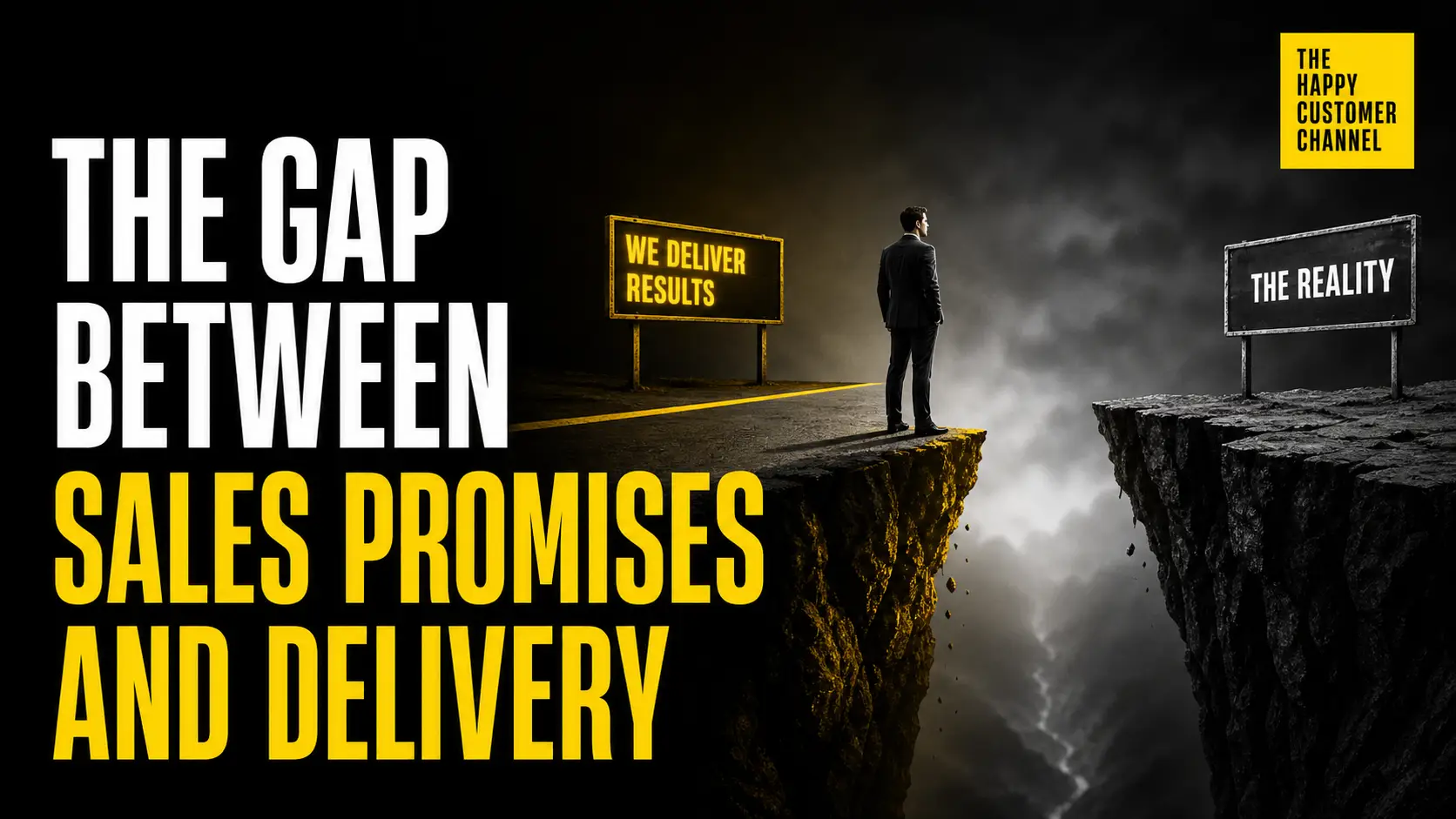
Sales and Customer Experience Alignment Is Revenue
The sale is not the finish line. It is the first public promise your company now has to prove.
That is where the tension starts. Sales makes the commitment. Delivery lives with the consequences. The customer does not separate the two.
To the customer, one company made one promise. That is why sales and customer experience alignment is not a nice internal initiative. It is revenue protection.
When Sales promises what Delivery cannot consistently execute, customer experience becomes a revenue leak, not a service issue. The company may book the deal, celebrate the win, and move on. But the customer is already measuring whether the truth matches the pitch.
And if it does not, trust starts dying early.
The Promise Is the First Product
Before a customer ever logs in, starts onboarding, attends a kickoff, or receives the first deliverable, they have already experienced your company.
They experienced your promise.
That promise might have sounded like a timeline. It might have sounded like a feature. It might have sounded like a strategic outcome, a service level, a customization, or a fast implementation.
Here’s what actually happens. Every statement made during the sales process becomes part of the customer’s perceived contract. Not the legal contract. The emotional contract. The one they remember when something takes longer than expected.
If Sales says, “This should be easy,” the customer hears low effort. If Sales says, “We can get you live in 30 days,” the customer builds a business plan around 30 days. If Sales says, “Our team will take care of that,” the customer assumes ownership has already been handled.
Then Delivery walks in.
Delivery asks for missing data. Delivery explains the process. Delivery uncovers dependencies. Delivery says the real timeline is 60 to 90 days. Delivery becomes the face of disappointment.
That is the dangerous part.
The team doing the real work gets blamed for breaking a promise they never made. The customer starts wondering who told the truth. Sales looks like the hero. Customer experience looks like the obstacle.
That is not alignment. That is operational debt.
What I’ve seen in growing companies is simple. The faster the sales motion gets, the more disciplined the promise needs to become. Growth creates pressure. Pressure creates shortcuts. Shortcuts create vague commitments. Vague commitments create customer friction.
The first product is not your software. It is not your service. It is not your implementation plan.
The first product is trust.
The Handoff Is Where Truth Gets Lost
Most companies think they have a handoff process. They have a CRM record. They have notes. They have a kickoff call. They have a checklist.
That is not enough.
A handoff that only transfers deal details is not a real handoff. It is an administrative pass. It tells the next team what was purchased, but not what was promised.
And that is where the damage lives.
The real information is usually buried in the conversation. What did the customer ask for? What did Sales imply? What risks were minimized? What objections were handled with confidence but not with proof? What exceptions were offered to close the deal?
Those details matter.
Because customers do not escalate over line items. They escalate over expectation gaps. They get frustrated when the experience feels different from the buying journey. They get angry when they feel like they were sold the clean version and handed the messy version.
The reality is, many post-sale teams are forced to start relationships by correcting the record.
That is a terrible place to begin.
Instead of momentum, you get damage control. Instead of confidence, you get skepticism. Instead of partnership, you get suspicion.
This is why leaders need to stop treating the sales-to-delivery gap like a communication issue. Communication matters, yes. But the deeper issue is accountability.
If Sales can promise exceptions without operational review, Delivery inherits risk disguised as revenue. If custom commitments are not documented, Customer Success inherits confusion. If deal quality is not measured, the company teaches the team that any revenue is good revenue.
It is not.
Bad-fit revenue is expensive. It consumes implementation capacity. It increases support load. It creates executive escalations. It hurts morale. It makes strong teams look weak because they are constantly trying to fulfill promises the business never validated.
That is how customer experience gets quietly damaged from the inside.
Alignment Must Be Built Into Revenue Mechanics
This is where sales and customer experience alignment gets practical.
It cannot live in a quarterly meeting. It cannot depend on good intentions. It cannot be solved by telling teams to “communicate better.” That sounds nice. It does not hold under pressure.
Alignment has to be built into how revenue is created, approved, handed off, and measured.
Start with promise boundaries. Sales should know exactly what can be said without approval, what needs validation, and what should never be promised. This is not about slowing Sales down. It is about keeping Sales credible.
Then build escalation rules. If a deal requires custom work, compressed timelines, special integrations, unusual service levels, or non-standard delivery, someone from the delivery side should review it before the customer hears yes.
Not after.
Before.
That one shift changes the game.
It turns Delivery from the cleanup crew into a strategic partner. It gives Sales confidence because they are not guessing. It gives the customer a cleaner buying experience because the promise is tied to reality.
Next, fix the handoff. A real handoff should answer three questions. What did we sell? What did we promise? What does the customer believe will happen next?
If your team cannot answer those three questions clearly, you are not ready for onboarding.
Finally, measure the right things. Do not only measure closed-won revenue. Measure early churn. Measure onboarding delays by source. Measure expectation resets. Measure escalations in the first 90 days. Measure how often customer-facing teams have to walk back something said during the sales process.
That data tells the truth.
And leaders need to have the courage to look at it.
Because the goal is not to blame Sales. The goal is to protect the customer relationship before it becomes fragile. Sales teams are under pressure. Delivery teams are under pressure. Customers are under pressure too.
The companies that win are the ones that make the promise real before the invoice goes out.
Final Thoughts
You do not fix broken promises with better customer service. You fix them by making the company accountable for the words it sells.
At the end of the day, customers do not care where the breakdown happened. They do not care which department owns which part of the journey. They care about whether the company did what it said it would do.
That is the standard.
If you want stronger retention, cleaner onboarding, fewer escalations, and better trust, stop treating the sale like the end of the customer journey. It is the beginning. And the promise you make there will either create momentum or create debt.
Common Questions
How do we know if Sales is overpromising or CX is underdelivering?
Listen, look for patterns. One rough onboarding does not prove overpromising. But if the same expectations keep showing up, you have a signal. If customers repeatedly say, “That is not what we were told,” pay attention. What I’ve seen is that early churn, repeated timeline resets, and first-90-day escalations often point back to the sales conversation. The question is not who to blame. The question is where the expectation broke.
Should customer experience be involved before the deal closes?
Here’s the reality. On simple deals, maybe not. On complex deals, absolutely. If there are custom requirements, tight deadlines, integrations, high-value accounts, or unusual commitments, CX or Delivery should have a voice before the customer hears yes. That does not slow revenue down. It prevents the company from selling work it cannot deliver profitably or consistently. Smart review protects everyone, including Sales.
What should Sales and CX actually align on?
What I’ve seen is that teams often align on process but miss the promise. They need to align on outcomes, timelines, limitations, customer responsibilities, implementation requirements, and success measures. That means being clear about what is included and what is not. It also means documenting what the customer believes they bought. If that belief is wrong, fix it before kickoff. Do not let Delivery discover it live with the customer.
How do we fix the gap without hurting sales momentum?
At the end of the day, speed does not come from avoiding discipline. Speed comes from removing rework. Create clear rules for what Sales can promise, what needs approval, and what must be documented before handoff. Give Sales simple language they can use when something needs validation. Give Delivery a seat on risky deals before the damage is done. The fastest teams are not the ones making the biggest promises. They are the ones making promises they can actually keep.