
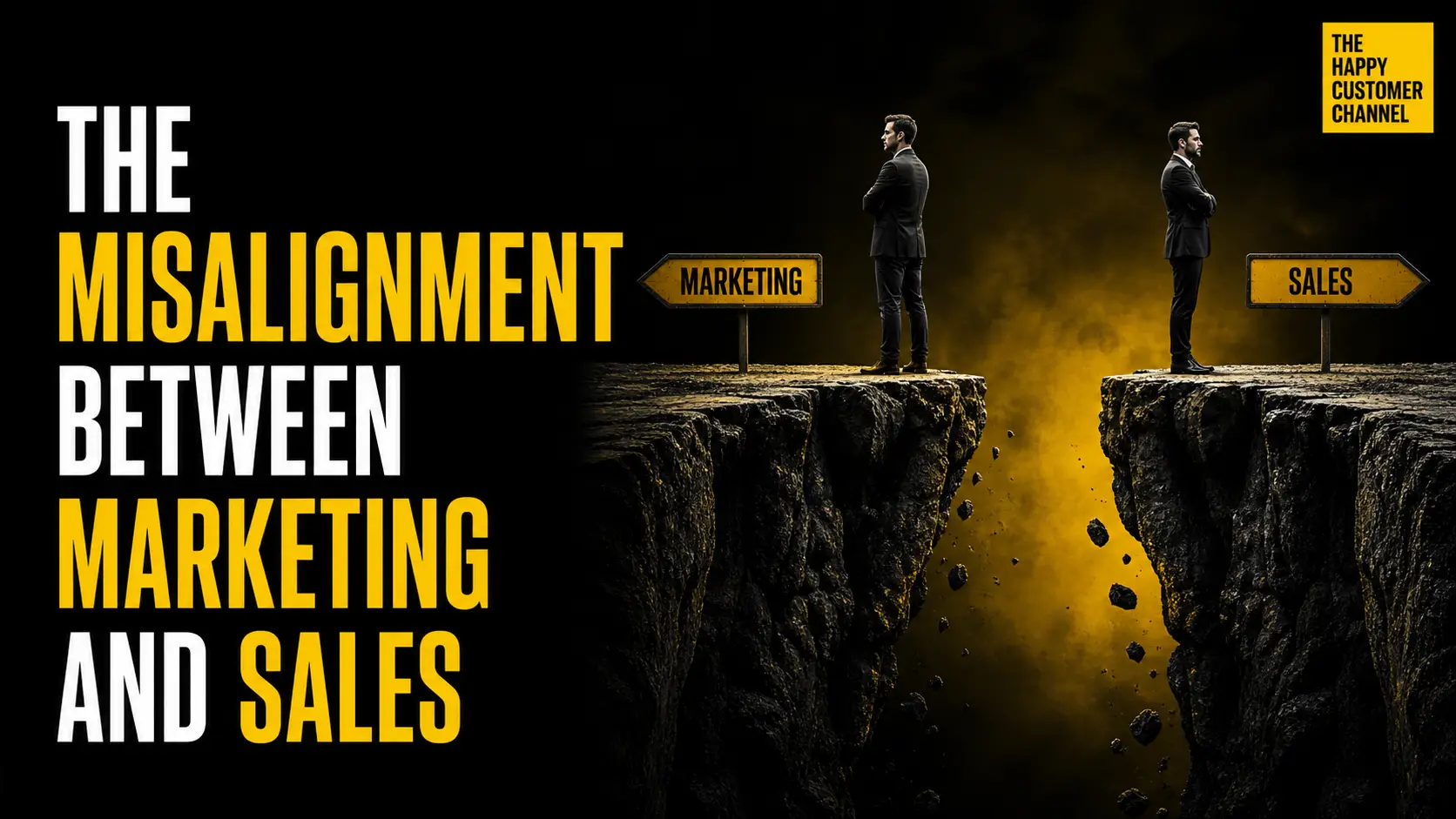
Marketing and sales do not drift apart because people stop talking.
They drift apart because the business rewards them for winning separately.
That is the real problem behind marketing and sales alignment. It is not a meeting problem. It is not a dashboard problem. It is not solved by putting both teams in the same Slack channel and hoping everyone suddenly starts thinking the same way.
Here’s what actually happens. Marketing gets measured on lead volume. Sales gets measured on closed revenue. Marketing celebrates form fills, campaign responses, and MQLs. Sales looks at the same names and says, “These people are not ready.” Then trust breaks. Quietly at first. Then publicly.
The reality is simple. If the operating model rewards different outcomes, the teams will behave differently. Every time.
Alignment Theater Is Not Alignment
A lot of companies think they have alignment because marketing and sales attend the same weekly meeting.
They do not.
They think they have alignment because everyone can see the CRM. They think they have alignment because dashboards exist. They think they have alignment because someone built lifecycle stages and gave them official names.
But activity is not alignment. Access is not alignment. A shared meeting is not a shared strategy.
What I’ve seen inside B2B revenue teams is this: people can sit in the same room and still operate from completely different realities.
Marketing says, “We generated 400 leads this month.” Sales says, “Only 12 were worth calling.” Marketing says, “Sales is not following up.” Sales says, “Marketing does not understand the buyer.” Both sides have data. Both sides have frustration. Both sides believe they are right.
And that is where the damage starts.
Because the business is not asking one clear question: Are we creating qualified revenue opportunities that sales can actually win?
That question changes everything. It moves the conversation away from volume. It moves the conversation away from blame. It forces both teams to look at the buyer, the fit, the timing, the pain, and the actual path to revenue.
Most companies do not have an alignment issue because people are lazy. They have an alignment issue because the system lets each team define success on its own terms.
That is alignment theater. It looks good in a leadership meeting. It feels organized. But underneath, the machine is pulling in two directions.
The Handoff Is Where Trust Breaks
The handoff between marketing and sales is where the truth shows up.
Not in the strategy deck. Not in the kickoff meeting. Not in the campaign recap. The truth shows up when a lead moves from marketing to sales and somebody has to decide whether that person is worth real selling time.
This is where things get personal.
Marketing worked hard to create demand. Sales is under pressure to hit the number. Nobody wants to waste time. Nobody wants to be told their work is low quality. But if there is no shared definition of a qualified buyer, every handoff becomes a judgment call.
And judgment calls create friction.
Here’s what actually happens. A buyer downloads a white paper. They attend a webinar. They click a few emails. The system scores them. Marketing marks them as qualified. Sales calls them and discovers they are a student, a consultant, a junior employee, or someone with no project, no urgency, and no authority.
Now sales stops trusting marketing.
Then marketing sees low follow-up rates and stops trusting sales.
The problem compounds. Lead routing gets slower. Feedback gets thinner. Sales reps cherry-pick. Marketing keeps pushing more volume to make the numbers look strong. Leadership sees activity, but pipeline quality stays weak.
This is not a small issue. It is a revenue leak.
The handoff should not be a hope. It should be a contract. Both teams need to agree on what qualifies a buyer before the buyer enters the sales motion. That means ICP fit. Clear pain. Engagement that matters. Company context. Buying signals. Disqualification rules. Timing. Ownership.
If that sounds basic, good. It is basic. That is why it is so dangerous when teams skip it.
A bad handoff teaches sales that marketing does not understand the market. A bad follow-up teaches marketing that sales does not value demand. Once that belief sets in, every report becomes ammunition.
And when teams start using data to defend themselves instead of improve the system, revenue suffers.
Revenue Needs One Operating System
Real marketing and sales alignment starts when the company stops treating marketing and sales like two separate departments connected by a handoff.
They are not separate in the mind of the buyer.
The buyer does not care who owns the email, the ad, the website, the discovery call, the proposal, or the follow-up. The buyer experiences one company. One message. One process. One level of confidence or confusion.
That is the standard.
If the buyer experiences one journey, the business needs one revenue operating system.
That does not mean everyone does the same job. Marketing still creates demand. Sales still converts opportunity. Customer teams still protect and expand relationships. But the definitions, data, feedback loops, and revenue goals have to connect.
One ICP. One view of what good looks like. One set of lifecycle stages that people actually use. One agreement on what makes an opportunity worth pursuing. One feedback loop that does not depend on hallway conversations or random Slack messages.
This is where leaders have to get honest.
If marketing is still being rewarded for raw lead volume, do not be surprised when the team optimizes for volume. If sales is only rewarded for closing what is easiest, do not be surprised when reps ignore anything that feels early or unclear. People follow the scoreboard.
Change the scoreboard and behavior changes.
Qualified pipeline matters. Sales acceptance matters. Conversion rates matter. Closed-lost reasons matter. Speed to lead matters. Deal quality matters. Revenue contribution matters. These are not marketing metrics or sales metrics. They are business metrics.
The strongest revenue teams I have seen do not argue about who gets credit first. They obsess over where the buyer is getting stuck.
That is the shift.
Instead of asking, “Did marketing deliver enough leads?” ask, “Are we attracting the right companies?” Instead of asking, “Did sales follow up?” ask, “Did the lead show enough intent and fit to justify sales time?” Instead of asking, “Who dropped the ball?” ask, “Where did the operating system create failure?”
That is a much better conversation. Harder, yes. More useful, absolutely.
Final Thoughts
You do not fix marketing and sales alignment by asking people to collaborate harder.
You fix it by removing the structures that reward them for succeeding in different directions.
At the end of the day, alignment is not about being friendly. It is about being accountable to the same revenue truth. Same buyer. Same definitions. Same operating system. Same scoreboard.
Anything less is theater.
Common Questions
Why do marketing and sales seem aligned in meetings but not in results?
Listen, agreement in a meeting is easy. Results expose the real operating system. People nod in the room because the words sound right, but the numbers show what is actually happening. Are the leads converting? Is sales following up fast enough? Is pipeline improving? Here’s the reality: if behavior does not change after the meeting, there was no alignment. There was just attendance.
Should marketing be measured on pipeline instead of leads?
Yes, but not in a lazy way. Pipeline matters, but quality matters more. What I’ve seen is that companies swing from measuring leads to measuring pipeline without fixing the definition of a qualified opportunity. That just creates a new way to argue. Marketing should be accountable for fit, intent, sales acceptance, and revenue contribution. Not just names in a database. Not just inflated pipeline. Real opportunities with a real chance to close.
How do we know if the problem is lead quality or sales follow-up?
Here’s the reality: you do not solve that with opinions. You solve it by looking at the pattern. Segment the data. Look at response time, contact rate, disqualification reasons, opportunity conversion, and closed-lost notes. If strong-fit leads are not being touched, you have a follow-up problem. If sales is touching leads and most are bad fit, you have a quality problem. If both are happening, you have a leadership problem because nobody owns the full revenue process.
What is the first thing we should fix?
Start with the definition of a qualified buyer. Not a lead score. Not a vague persona. A real definition both teams can use under pressure. Who are we trying to reach? What makes them a fit? What signals show they are worth sales time right now? At the end of the day, if marketing and sales cannot agree on who is worth pursuing, everything downstream will break.