
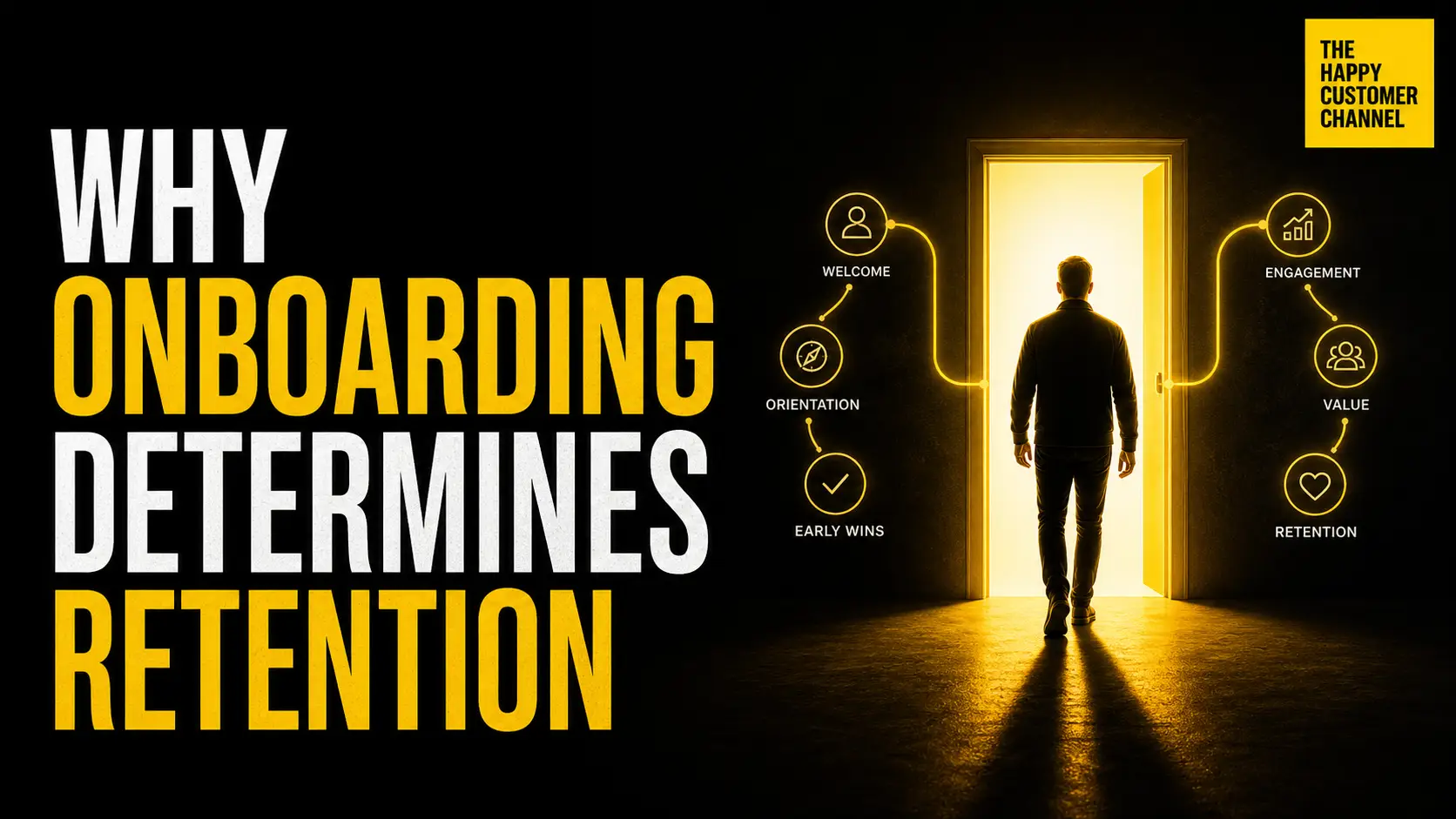
Your Customer Onboarding Process Is Retention

Most companies don’t lose customers at renewal. They lose them in onboarding. Renewal is just when the damage finally shows up on the dashboard.

The customer onboarding process is the first real test of your promise. Sales created belief. Marketing created urgency. The contract created commitment. But onboarding is where the customer asks, “Was this actually the right decision?”

That moment matters. A lot.

Because customers do not judge you by your internal process. They judge you by progress. They judge you by clarity. They judge you by how quickly the promise they bought starts turning into something they can feel, measure, and defend inside their business.

Here’s the reality: if onboarding feels slow, confusing, or disconnected, trust starts leaking immediately. Not loudly. Not dramatically. Quietly. One delayed kickoff. One unclear next step. One stakeholder left out. One “Wait, didn’t we already explain this during sales?”

That is how retention starts breaking before your team even calls the account “live.”

Retention Starts Before Renewal

Churn rarely begins at the renewal conversation. That is just the official moment. The real decision starts much earlier.

It starts when the customer realizes the experience after purchase does not match the confidence they had before purchase. That gap is dangerous. During the sales cycle, everything felt clear. The pain was understood. The outcome was defined. The team was responsive. The customer felt seen.

Then the deal closes.

And suddenly the energy changes. The customer gets handed to a new team. They repeat their goals. They explain their business again. The urgency drops. The language shifts from outcomes to setup. What used to feel strategic now feels administrative.

That is where doubt enters.

What I’ve seen over and over is this: customers forgive hard work. They do not forgive confusion. If the path is clear and the value is obvious, they will stay engaged. But if they feel like they are managing your process instead of being led through it, you are creating risk.

Onboarding is not a post-sale task. It is the first retention event.

That changes how you run it. It changes who owns it. It changes what you measure. You stop asking, “Did we complete onboarding?” and start asking, “Did the customer reach first value with confidence?”

Those are different questions. One is internal. The other is what the customer actually cares about.

The Handoff Is Where Trust Breaks

Sales sells outcomes. Onboarding often receives tasks.

That is the problem.

The customer bought a business result. Lower manual work. Faster reporting. Better adoption. Cleaner operations. Less revenue leakage. Whatever the promise was, it had a reason behind it. It had pressure behind it. It had people inside the company who needed that result to happen.

But too many handoffs reduce that entire story into notes, fields, and implementation steps. The emotion disappears. The urgency disappears. The “why” disappears.

Here’s what actually happens. Sales knows the pain. The customer success team gets the account. Implementation gets the checklist. Product gets a request later when something breaks. Nobody is trying to create a bad experience, but the customer feels the disconnect instantly.

They have to repeat themselves.

That is not a small thing. Repetition tells the customer your teams are not connected. It tells them the information they gave during the buying process did not matter. It tells them the relationship is starting over from zero.

And customers notice.

A strong handoff does not mean a long internal meeting. It means the receiving team understands the promise, the buyer’s pressure, the success metrics, the key stakeholders, the risks, and the first meaningful outcome the customer expects to see.

Not someday. Early.

If your onboarding team cannot answer, “What does success look like for this customer in the first 30 to 60 days?” then you are not ready to lead that customer. You are ready to process them. There is a big difference.

Build Onboarding Around Proof, Not Process

A strong customer onboarding process is not built around checkboxes. It is built around proof.

Proof that the customer made the right decision. Proof that your team understands the business problem. Proof that value is moving closer. Proof that the people involved know their roles. Proof that friction is being caught before it becomes frustration.

This is where many companies get it wrong. They measure onboarding like an internal project. Kickoff completed. Training delivered. Admin configured. Data imported. Box checked. Account marked live.

Fine. But did the customer get value?

Did the main stakeholder see progress they can explain to their boss? Did the users understand why the product matters? Did usage start in the places that connect to the original business case? Did your team identify early warning signs, or did you wait until adoption dropped?

Activity does not equal confidence.

The better move is to define first value before the kickoff. Not during. Not after. Before. Your team should know the first outcome that will make the customer say, “Okay, this is working.” That moment becomes the center of onboarding.

Then you build backward.

Who needs to be involved? What needs to be configured? What data matters? What behavior needs to change? What risk could slow this down? Who has authority if decisions stall?

This is not complicated. But it does require discipline.

Stop treating onboarding completion as the finish line. Completion is not the goal. Confidence is the goal. Momentum is the goal. A customer who reaches first value quickly is easier to retain, easier to expand, and easier to turn into an advocate.

That is not theory. That is what happens when onboarding is designed around the customer’s reality instead of your internal comfort.

Final Thoughts

Customers do not renew because they were welcomed. They renew because they saw proof early enough to believe they made the right decision.

If onboarding creates clarity, speed, ownership, and measurable progress, retention gets stronger. If onboarding creates confusion, delay, and repeated explanations, churn is already forming.

At the end of the day, onboarding is where the customer decides whether your promise was real.

Common Questions

How long should a customer onboarding process take?

Listen… the answer is not “30 days” or “90 days.” The answer is: long enough to reach first meaningful value, and not a day longer than necessary. Too many companies confuse time with thoroughness. The customer does not care how many steps are in your internal plan. They care when they can see progress. If your timeline is built around your team’s checklist instead of the customer’s first win, you are already creating risk.

What should we measure during onboarding?

Here’s the reality: completed tasks are not enough. You need to measure time-to-first-value, stakeholder participation, product usage, unresolved friction, and whether the original business outcome has a clear owner. If nobody owns the outcome, the account drifts. If key stakeholders disappear, the account is at risk. If usage starts low and stays low, do not wait for renewal to call that a problem. The signals are there early if you are willing to look.

Should customer success or sales own onboarding?

What I’ve seen is that both teams have accountability, but not the same accountability. Sales owns the accuracy of the promise. Customer success owns the path to value. If sales overpromises, onboarding inherits a trust problem. If customer success ignores the business reason behind the purchase, the customer gets a process instead of a result. The customer should never have to pay for your org chart.

How do we know if onboarding is causing churn later?

At the end of the day, churn leaves clues. Look for delayed activation, weak usage after launch, repeated customer confusion, missing stakeholders, and renewal feedback tied to unmet expectations. If customers say they “never really got value,” that usually did not start in month eleven. It started when onboarding failed to connect the product to the outcome. Ask better questions earlier. The renewal conversation will get a lot easier.

Your Customer Onboarding Process Drives Retention

Retention is not won at renewal. It is won or lost in the first 30 days. That is where trust either gets stronger or starts leaking. A weak customer onboarding process does not create churn later. It creates churn immediately. The customer just has not said it out loud yet.

Most companies do not want to hear that. They would rather blame pricing. Or product gaps. Or a tough economic environment. Sometimes those things matter. But what I’ve seen over and over is this: the customer decided how confident they felt about you long before the renewal conversation showed up.

That decision starts right after the contract is signed. Expectations are high. Attention is sharp. The buyer is watching. The team is watching. Everyone wants proof that this was the right call. If onboarding feels slow, vague, or disconnected from what was promised, you are already behind.

Retention Starts Before the Customer Feels Safe

There is a moment after the sale that most companies underestimate.

The customer has signed. The deal is closed. The sales team celebrates. Finance books the revenue. Everyone internally feels like something has been completed.

But for the customer, nothing has been completed. The risk has just become real.

They now have to prove the decision was smart. They have to justify the spend. They have to get internal teams aligned. They have to explain why people need to change how they work. That is not a small thing.

So what are they looking for?

Confidence.

Not a product tour. Not a login. Not a 60-minute call full of feature explanations. They are looking for early proof that your company understands what they are trying to accomplish.

This is where many teams miss the mark. They treat onboarding like orientation. “Here is how the platform works.” “Here is where the settings live.” “Here is your help center.” That may be useful, but it is not enough.

The reality is simple. Customers do not retain because they were trained. They retain because they saw value fast enough to believe the journey was worth continuing.

If the first few weeks feel messy, the customer starts forming a story. Maybe this is harder than we thought. Maybe the sales process made it sound easier. Maybe our team will not adopt this. Maybe we should have waited.

That story matters. Once it starts, it is hard to unwind.

The Handoff Is Where Trust Leaks

Here’s what actually happens inside too many companies.

Sales sells the outcome. Onboarding delivers the tasks.

That gap is dangerous.

The customer bought a result. More efficiency. Better visibility. Faster response times. Lower cost. Higher retention. Whatever the promise was, it had business meaning. Then onboarding begins, and suddenly the conversation shifts to access, integrations, permissions, fields, workflows, and timelines.

Those things matter. Of course they do. But they are not the reason the customer bought.

When customer success or implementation does not inherit the real business context, the customer feels it immediately. They feel like they are starting over. They have to explain the problem again. They have to repeat goals. They have to re-educate a team that should already know why they are there.

That is trust leakage.

Not dramatic. Not loud. But very real.

What I’ve seen is that weak handoffs create the first emotional drop in the customer relationship. The buyer starts asking quiet questions. Did sales understand us? Did they pass anything along? Is this team prepared? Are we just another account in the queue?

This is why the sales-to-success handoff cannot be a formality. It has to transfer context, risk, expectations, stakeholder dynamics, and the definition of success. Not just the contract details. Not just the package purchased.

A strong customer onboarding process starts before the kickoff call. It starts with alignment inside your own company. If your teams are not aligned, do not expect the customer to feel aligned.

The kickoff should not feel like discovery from scratch. It should feel like momentum.

Early Value Is the Metric That Matters

Most onboarding teams track activity.

Calls completed. Tasks finished. Users invited. Training sessions delivered. Implementation milestones checked off.

That is not bad. But it is incomplete.

Activity is not value.

You can finish every task and still leave the customer wondering whether anything meaningful has changed. You can complete onboarding on schedule and still fail to create confidence. That is the part many leaders miss.

The best teams define the first measurable win before onboarding begins. Not someday. Not after full adoption. Not after the customer becomes an expert. Early.

What is the first signal that the customer is getting value?

It might be the first workflow running correctly. It might be the first report used in a leadership meeting. It might be a reduction in manual work. It might be a team using the product without being pushed. It might be one department seeing a clear improvement fast enough to create internal belief.

The point is not that every customer has the same first win. They do not.

The point is that every customer needs one.

Time-to-value is one of the clearest indicators of customer health. When value shows up early, customers lean in. They ask better questions. They bring more people into the process. They start connecting the product to bigger goals.

When value is delayed, customers pull back. They miss meetings. They slow down decisions. They stop inviting key stakeholders. Then months later, everyone acts surprised when the renewal is at risk.

It was not sudden.

It was visible.

The signs were there in onboarding.

This is why leaders need to stop asking only, “Did we onboard them?” The better question is, “Did they experience the value they bought?” That question changes the entire operating model.

It forces teams to measure adoption differently. It forces better handoffs. It forces clearer success criteria. It forces accountability around outcomes, not just motion.

Final Thoughts

If you need a heroic renewal push to save the account, the failure probably happened months earlier. Retention is not a last-minute rescue mission. It is built through early confidence, clear value, and disciplined execution. Get onboarding wrong, and every team downstream pays for it. Get it right, and retention stops feeling like a fight.

Common Questions

How long should a customer onboarding process actually take?

Listen, there is no magic number. It depends on the product, the customer complexity, and the outcome they bought. But here’s the reality: long onboarding is not automatically bad. Unclear onboarding is bad. If the customer knows what is happening, why it matters, and when they should expect value, they will stay engaged. If they feel lost, even a two-week onboarding can feel painful.

What should we measure during onboarding besides task completion?

What I’ve seen is that task completion gives teams a false sense of confidence. You need to measure whether the customer is moving toward value. Are the right stakeholders involved? Are users activating? Is the customer using the product in a way tied to the original business goal? Did they hit a first meaningful win? At the end of the day, completed tasks do not matter if the customer still feels unsure.

How do we know if poor onboarding is causing churn?

Here’s the reality: look backward from churned accounts and study the first 30 to 60 days. Were kickoff goals clear? Was there a strong handoff from sales? Did the customer reach value quickly? Were decision-makers still engaged after onboarding? If you see weak adoption, missed milestones, unclear ownership, and slow value, you are not looking at a renewal problem. You are looking at an onboarding problem that finally became visible.

Who should own onboarding: sales, customer success, or implementation?

Listen, ownership depends on your model, but accountability cannot be blurry. Sales owns the promise. Customer success owns the relationship and outcome. Implementation may own the technical path. But the customer does not care about your org chart. They care about progress. Someone has to be clearly responsible for making sure the customer gets to value without feeling passed around.